
Photograph by Fernando Guerra
Zaragoza, Spain
2005 - 2008
Expoagua Zaragoza
Zaragoza Bridge Pavilion
Photograph by Fernando Guerra
Photograph by Luke Hayes
June 2008
Photograph by Luke Hayes
June 2008
Photograph by Fernando Guerra
01
02
03
04
A result of detailed examination and research
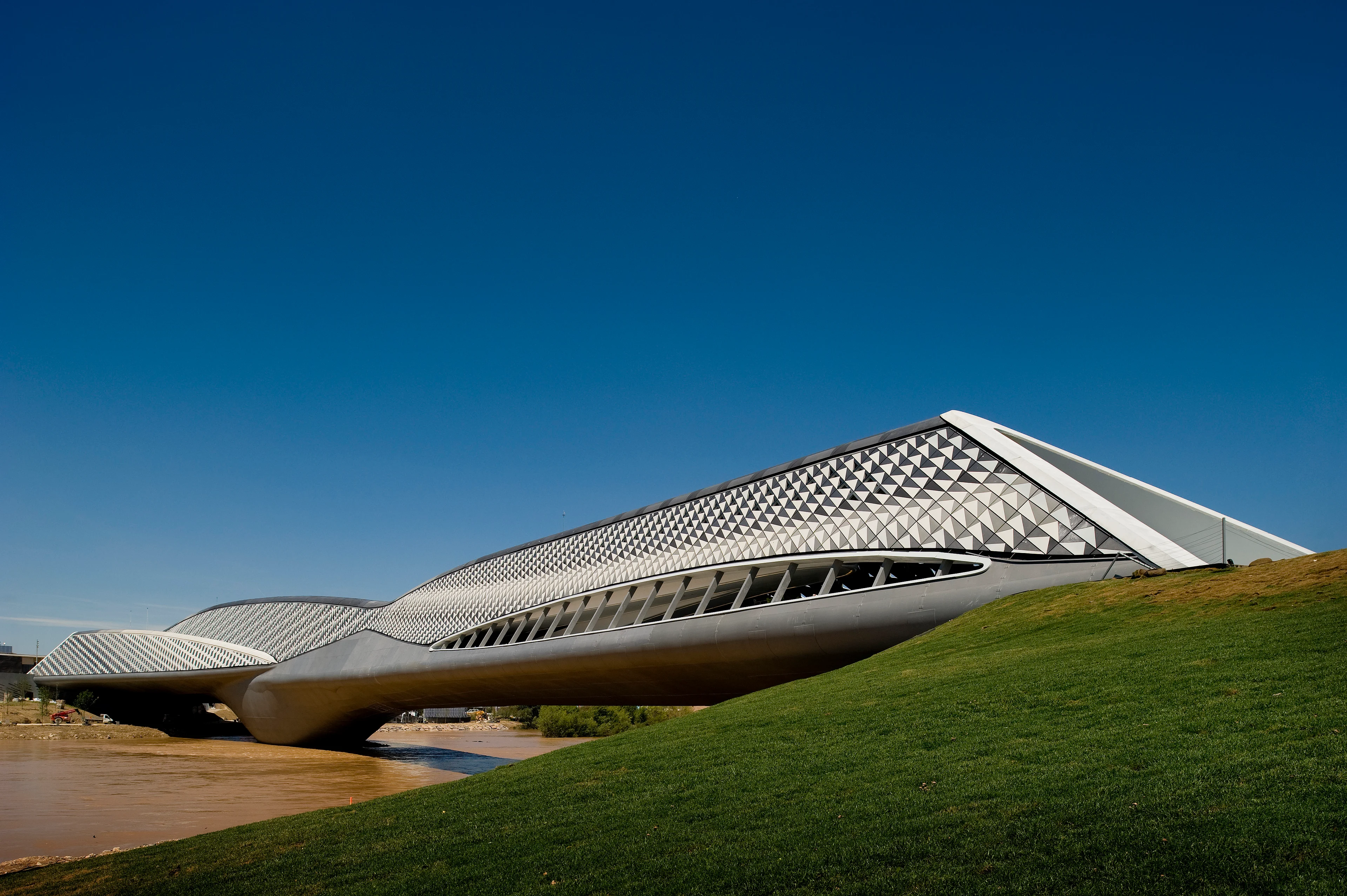
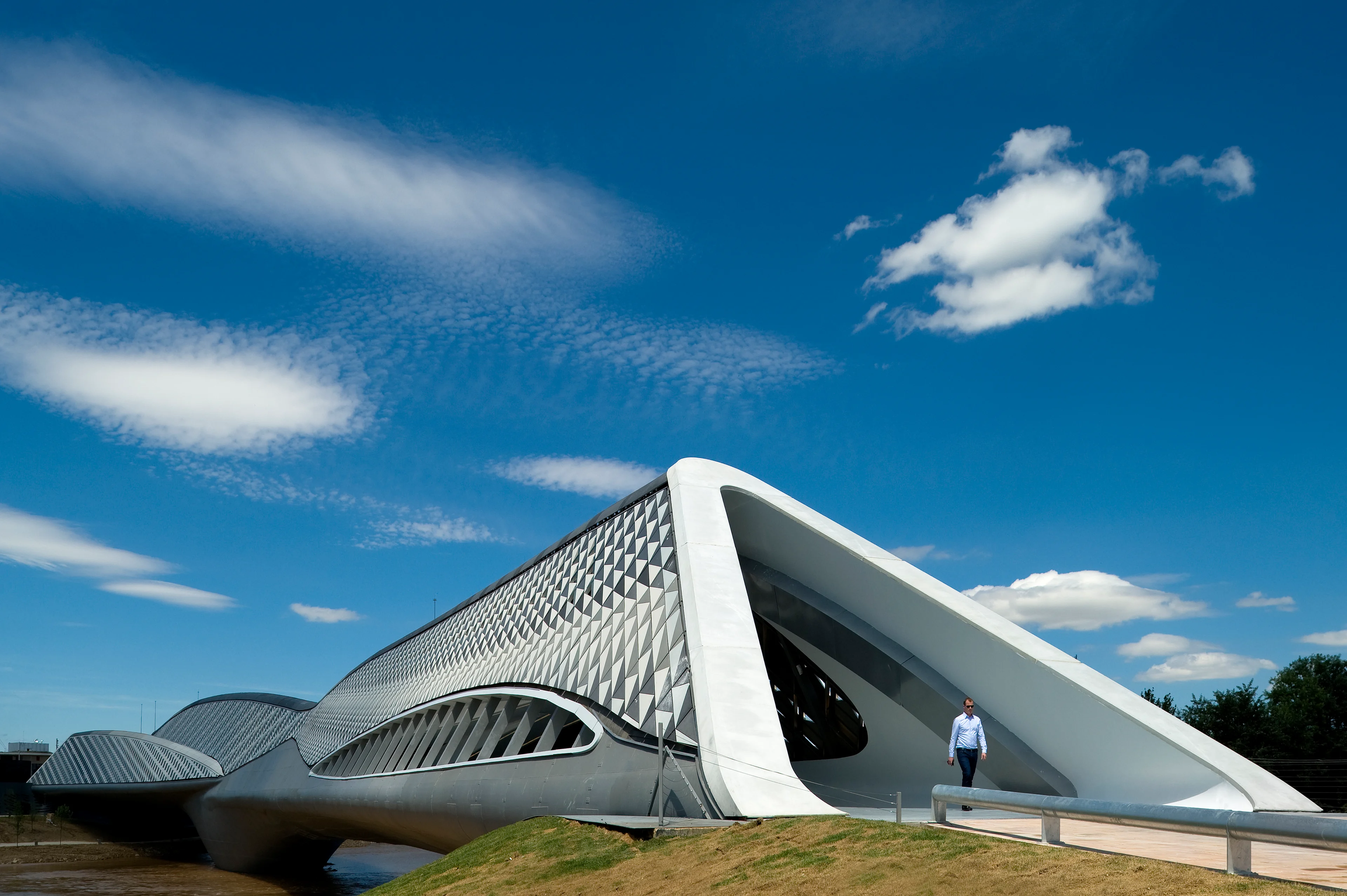
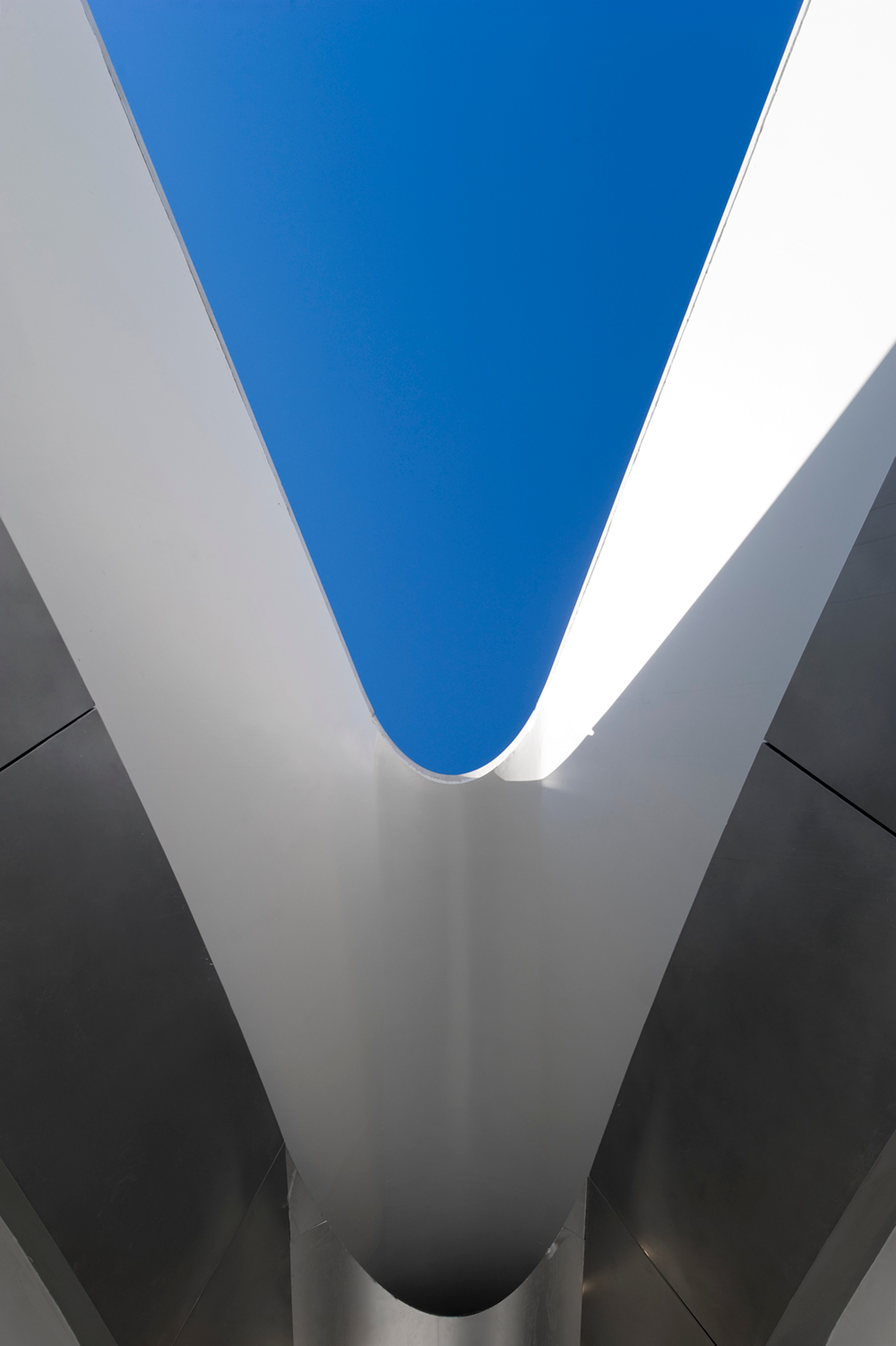
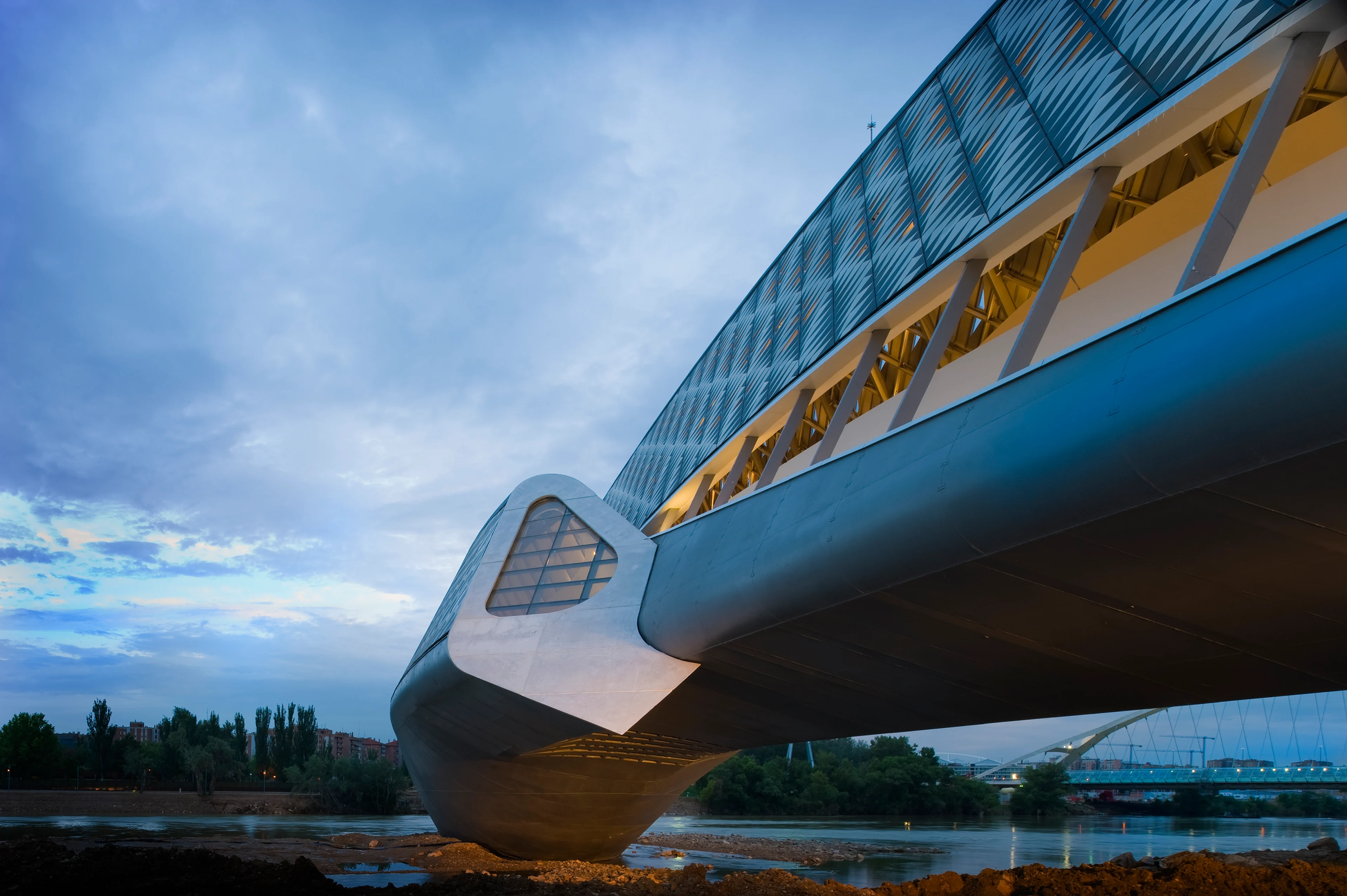
The Zaragoza Bridge Pavilion is organized around 4 main elements, or “pods”, that perform both as structural elements and as spatial enclosures. The Bridge Pavilion design is a result of detailed examination and research into the potential of a diamond shaped section which offers both structural and programming properties. As in the case of space-frame structures, a diamond section can efficiently distribute forces along a surface, whilst underneath the floor plate the resulting triangular pocket space can be used to run services.
The diamond section has also been extruded along a slightly curved path. The extrusion of this rhombus section along different paths has generated the four separate ‘pods’ of the Bridge Pavilion. The stacking and interlocking of these truss elements (the ‘pods’) satisfies two specific criteria: optimizing the structural system, and allowing for a natural differentiation of the interiors - where each ‘pod’ corresponds to a specific exhibition space. By intersecting the trusses/pods, they brace each other and loads are distributed across the four trusses instead of a singular main element, resulting in a reduction in size of loadbearing members.
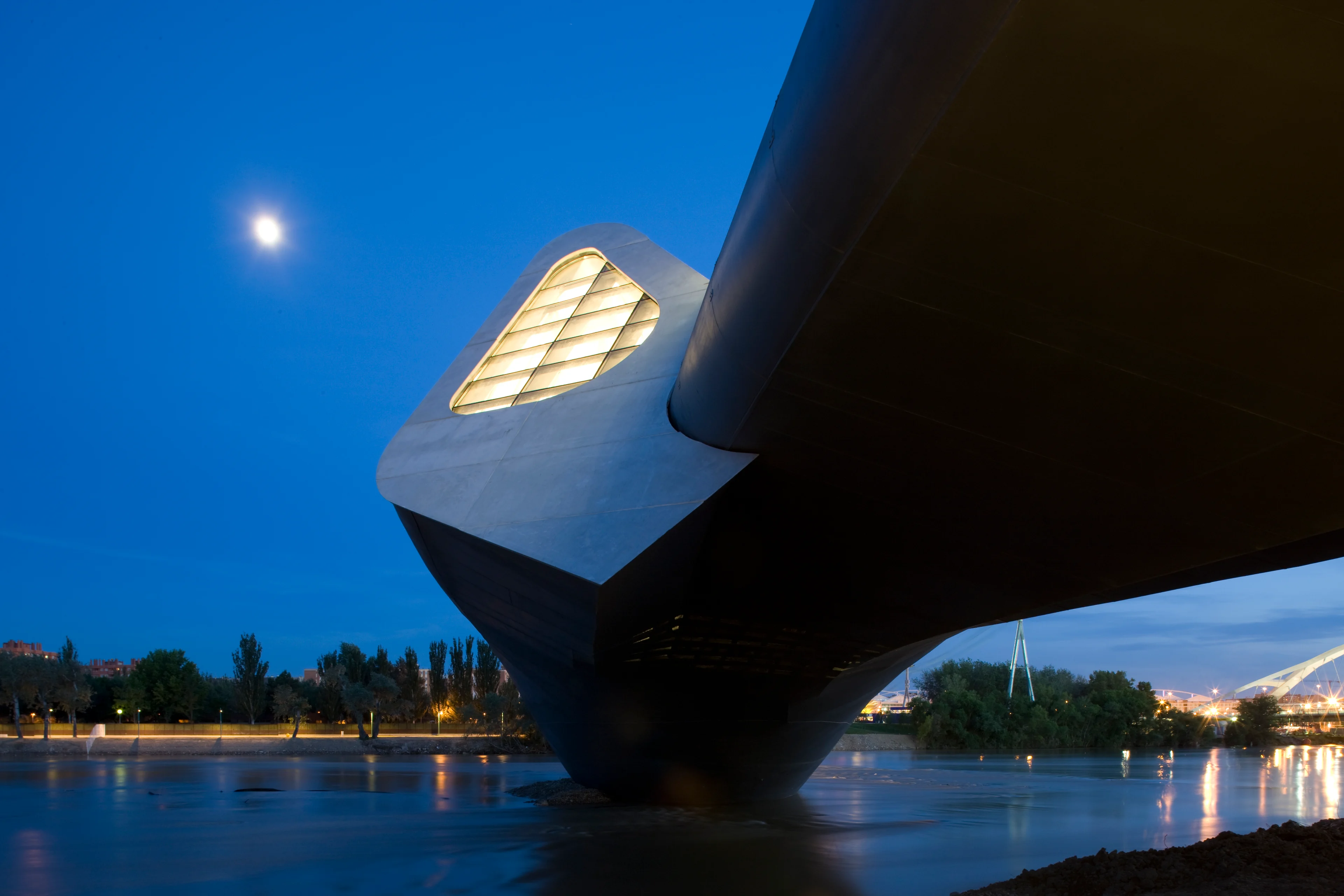
Located above the main flood level, the Bridge Pavilion connects with each river bank via a smooth inclined terrain. Each pod is located on the same level, except one which is 1.5 meters above this main level and intersects with its adjacent pods. All but one of the pods include an upper floor, which hangs from the diamond section structure and provides views of the lower level.
Photograph by Fernando Guerra
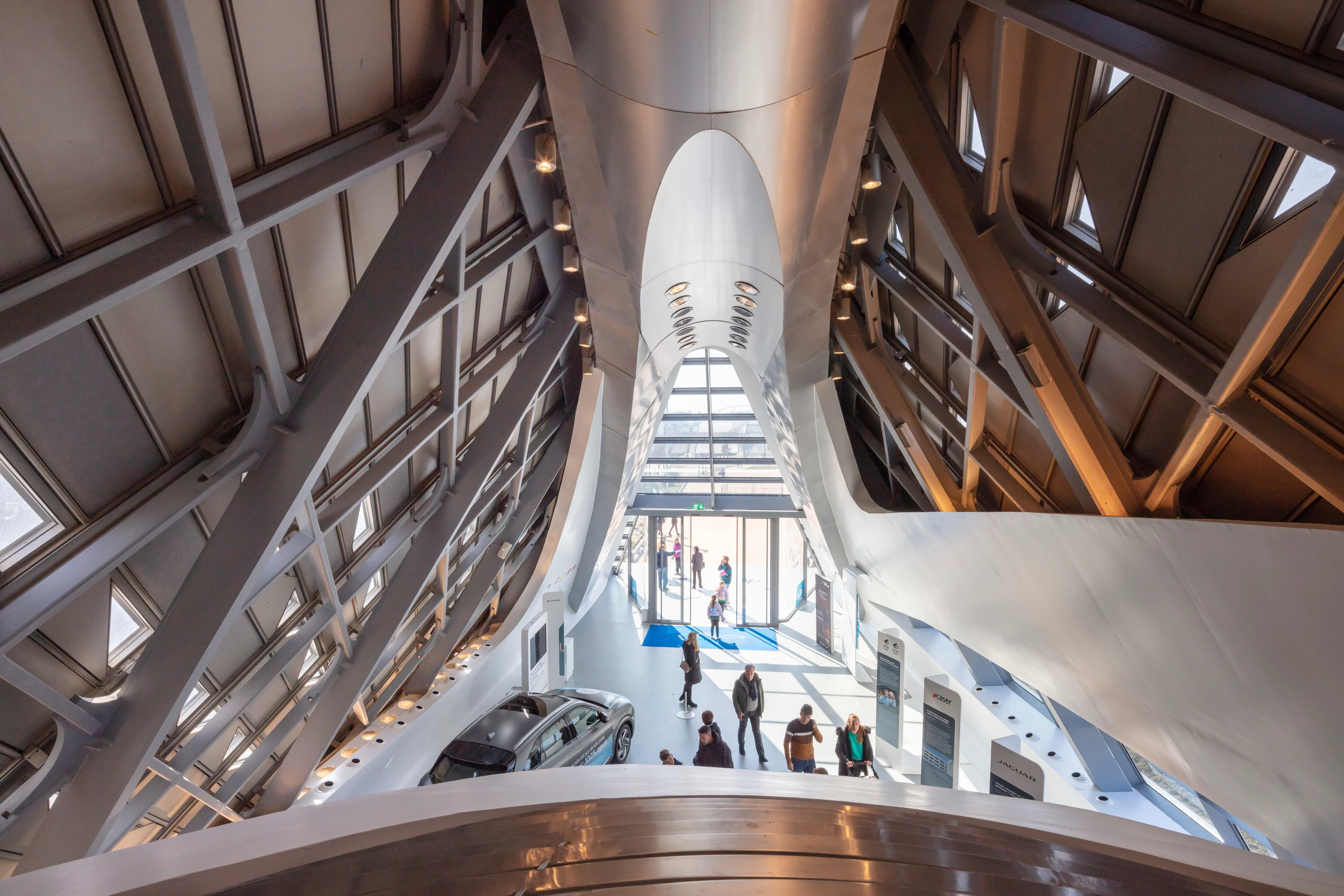
Each zone within the building has its own spatial identity
All pods are stacked according to precise criteria - aimed at reducing the Bridge Pavilion’s section as much as possible where the span is longer (approximately 185m from the island in the middle of the river to the right bank), and enlarging the section where the span is shorter (85m from the island to the Expo riverbank). One long pod spans from the right riverbank to the island, where the other three are grafted into it, spanning from island to left bank.
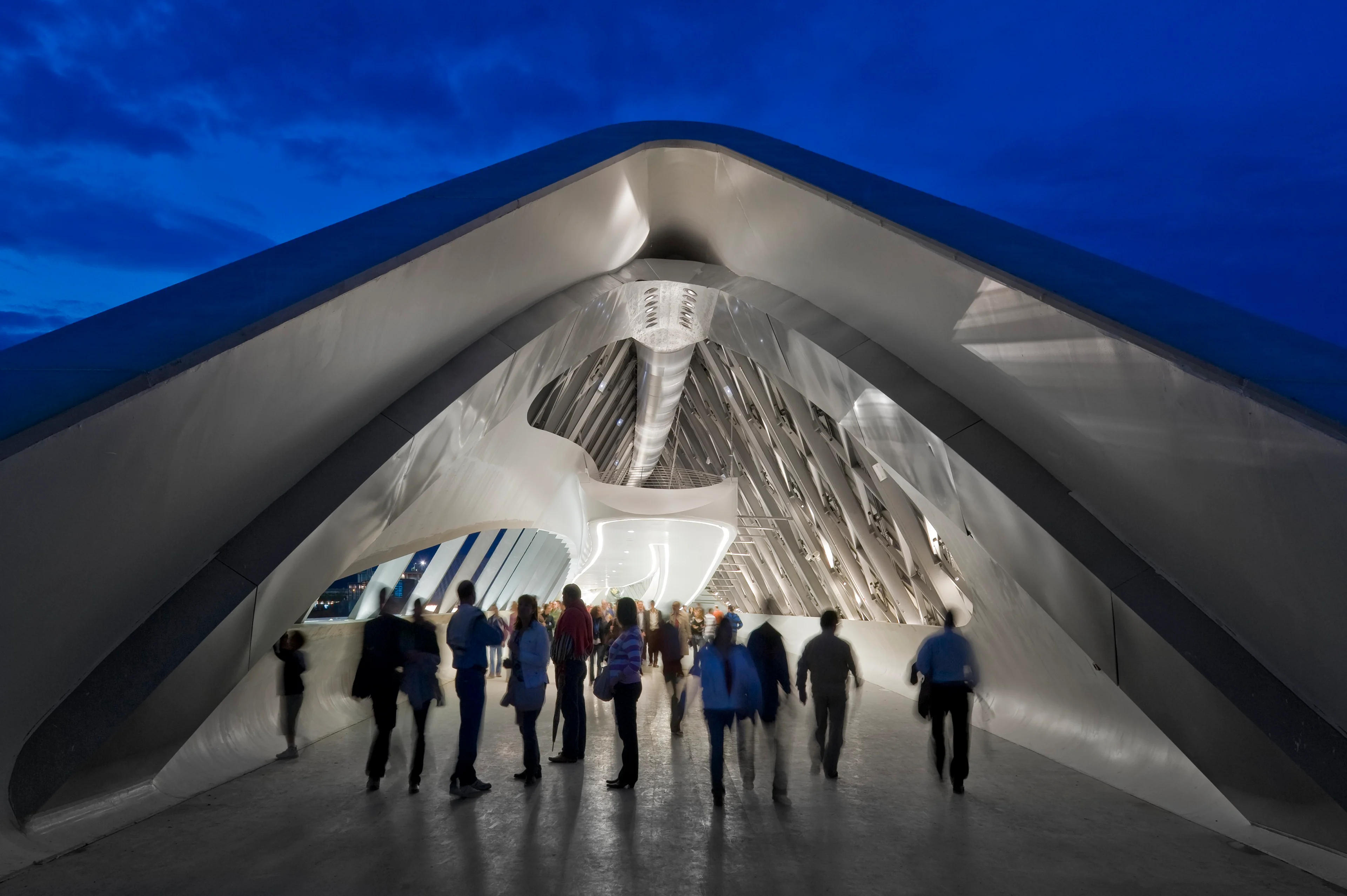
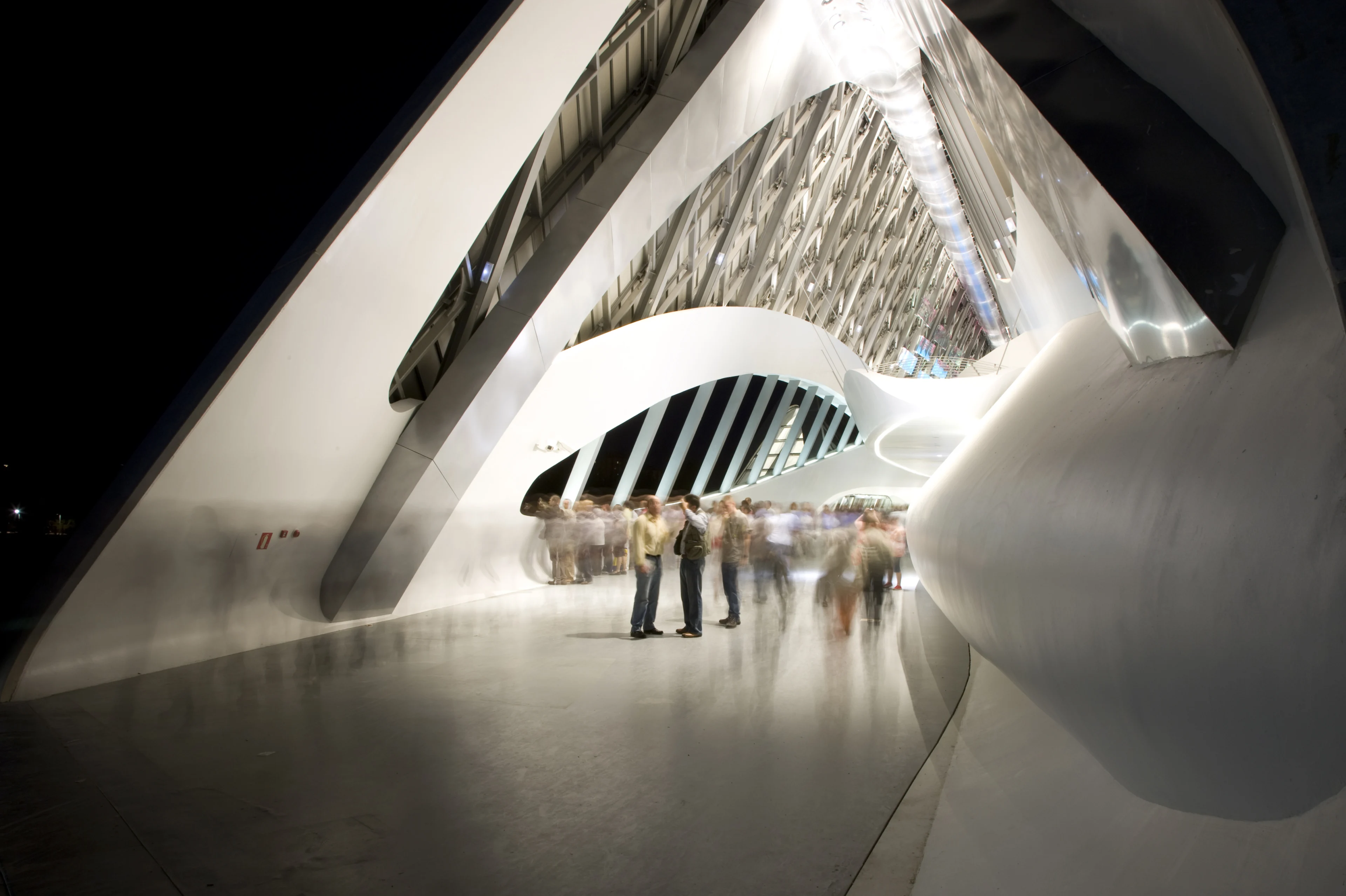
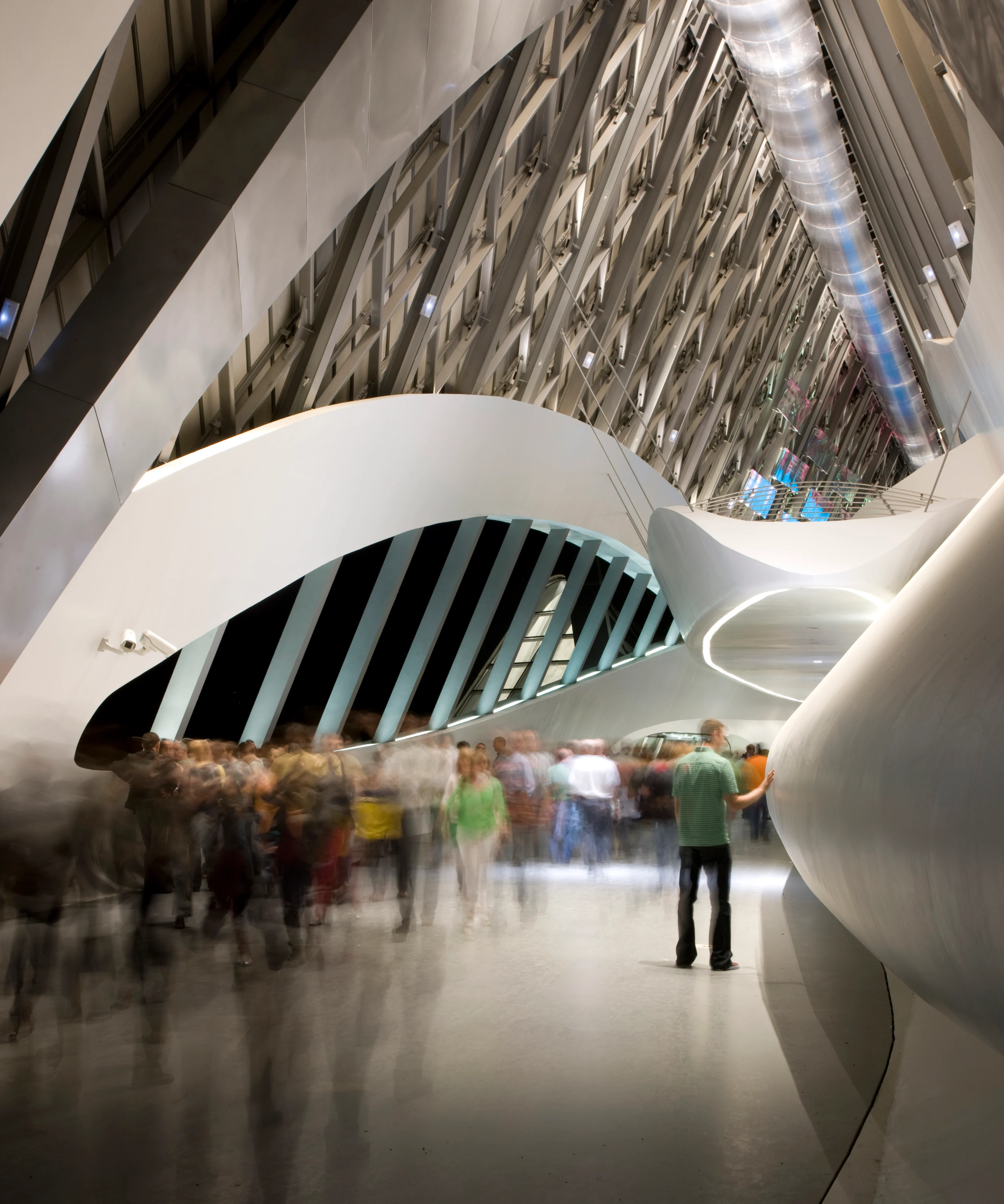
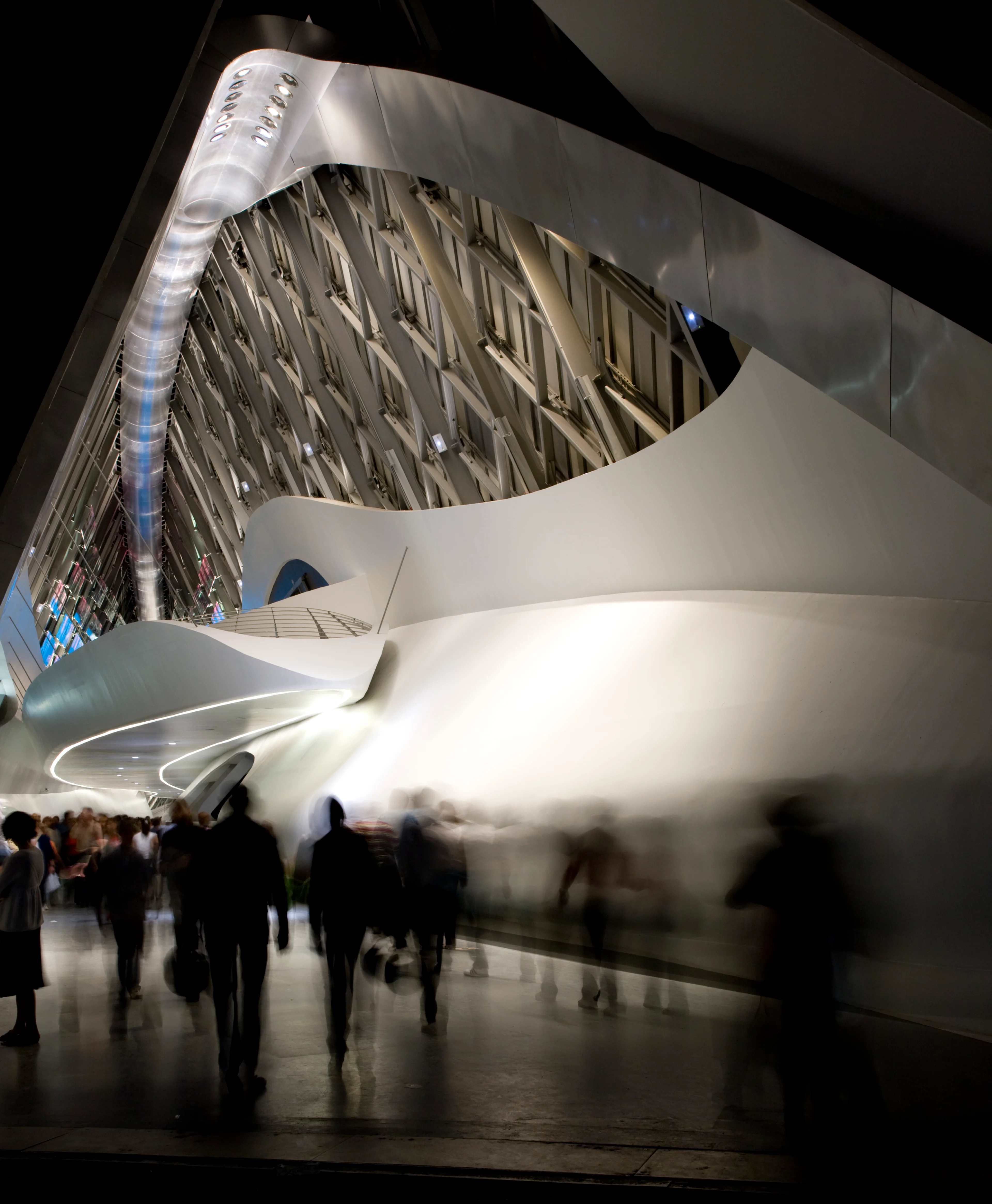
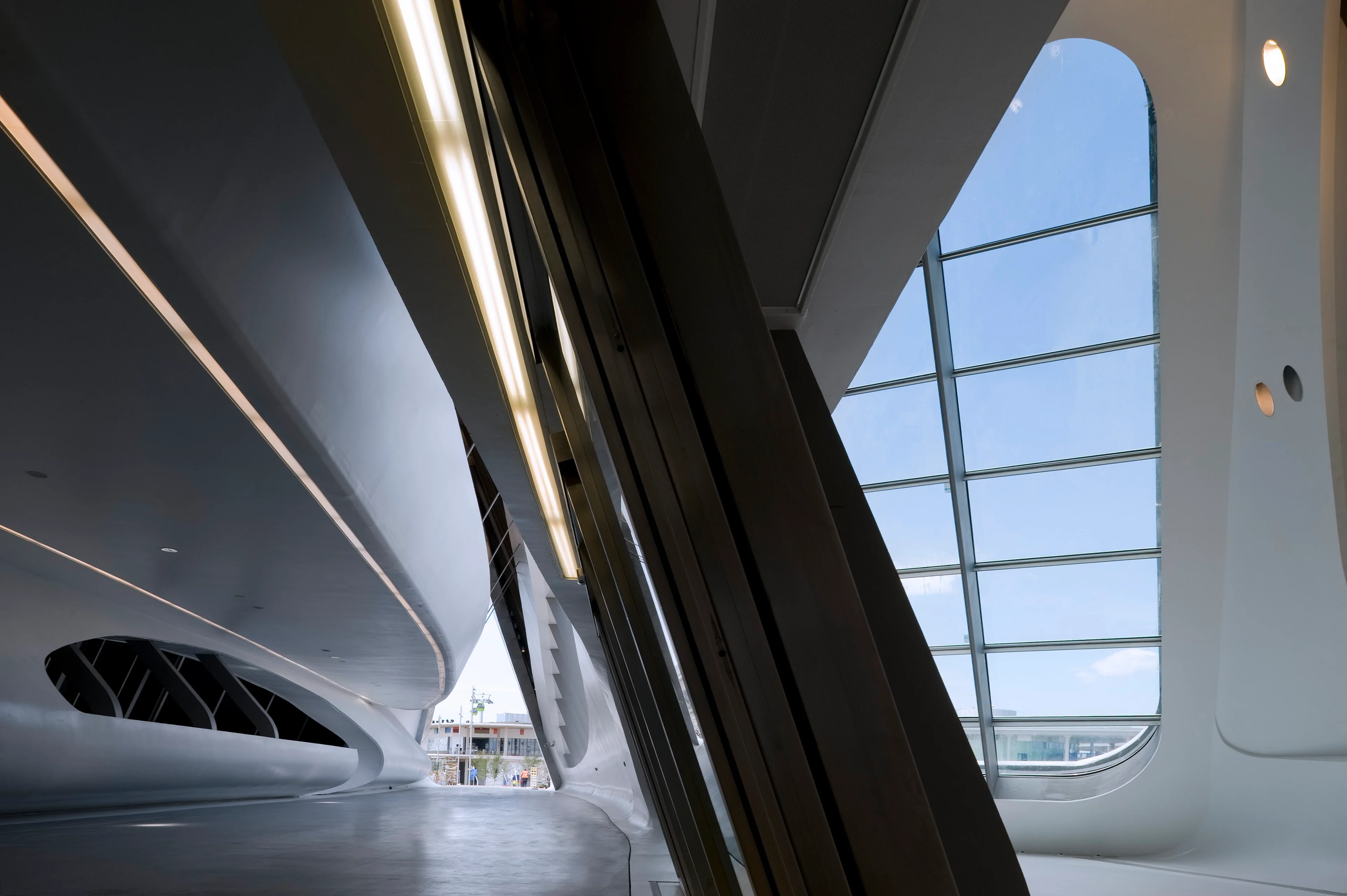
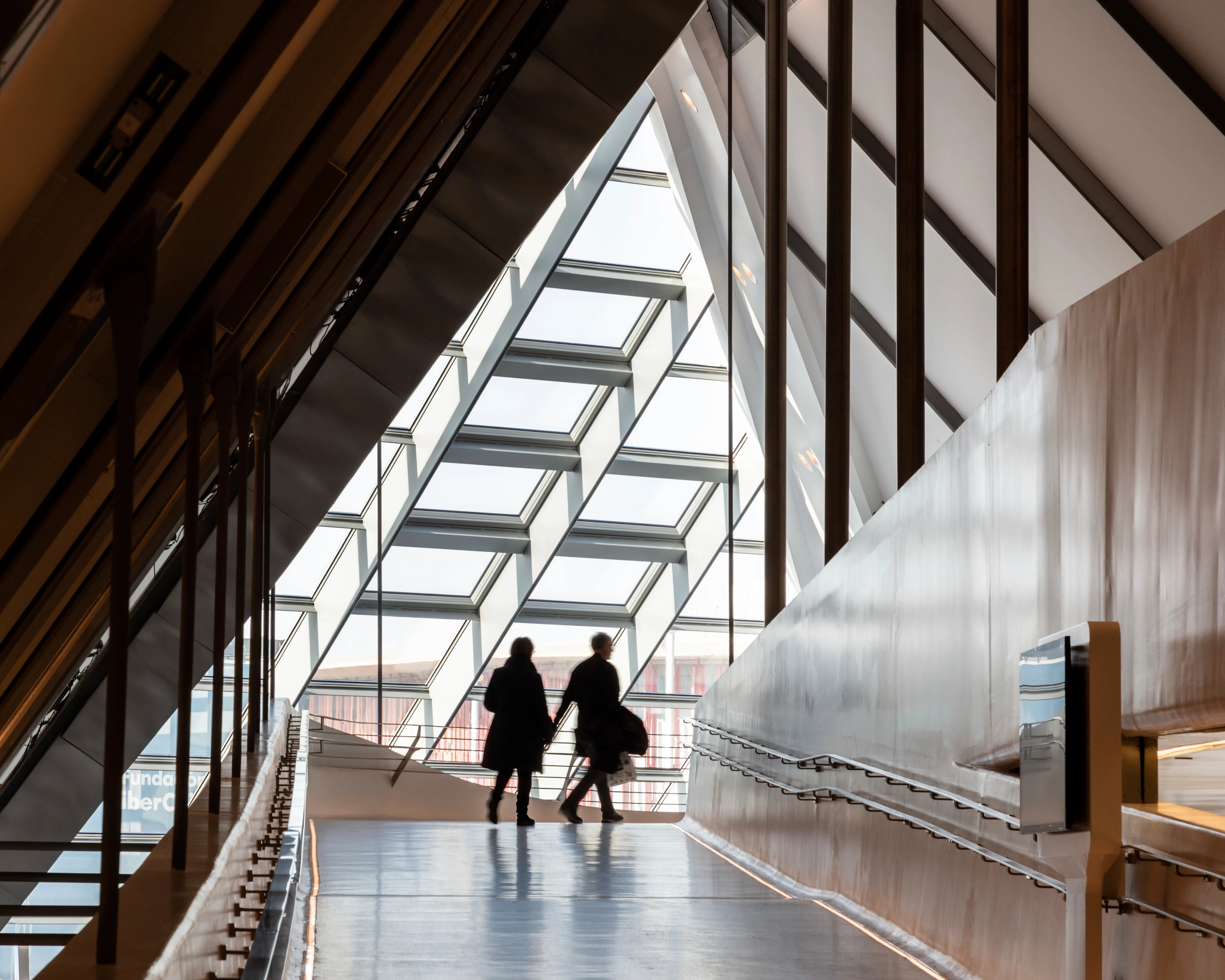
This interlocking of the pods has given the design many exciting possibilities. Interiors become complex spaces, where visitors move from pod to pod through small in-between spaces that act as filters - or buffer zones. These zones diffuse the sound and visual experience from one exhibition space to the next, allowing for a clearer understanding of the content within each pod. The identity of each pod remains evident inside the pavilion, almost performing as a three-dimensional orientation device.
Spatial concern is one of the main drivers of this project. Each zone within the building has its own spatial identity. Their nature varies from completely enclosed interior spaces that focus on the exhibition, to open spaces with strong visual connections to the Ebro River and the Expo.
Photograph by Fernando Guerra
Functional, visually appealing and economical
The design capitalizes on the ambiguous nature of the original brief, maintaining both the aspect of a traditional bridge (open to the environment with the steel structure being the dominant visual element) and that of a more conventional exhibition pavilion where climate and light permeability are controlled.
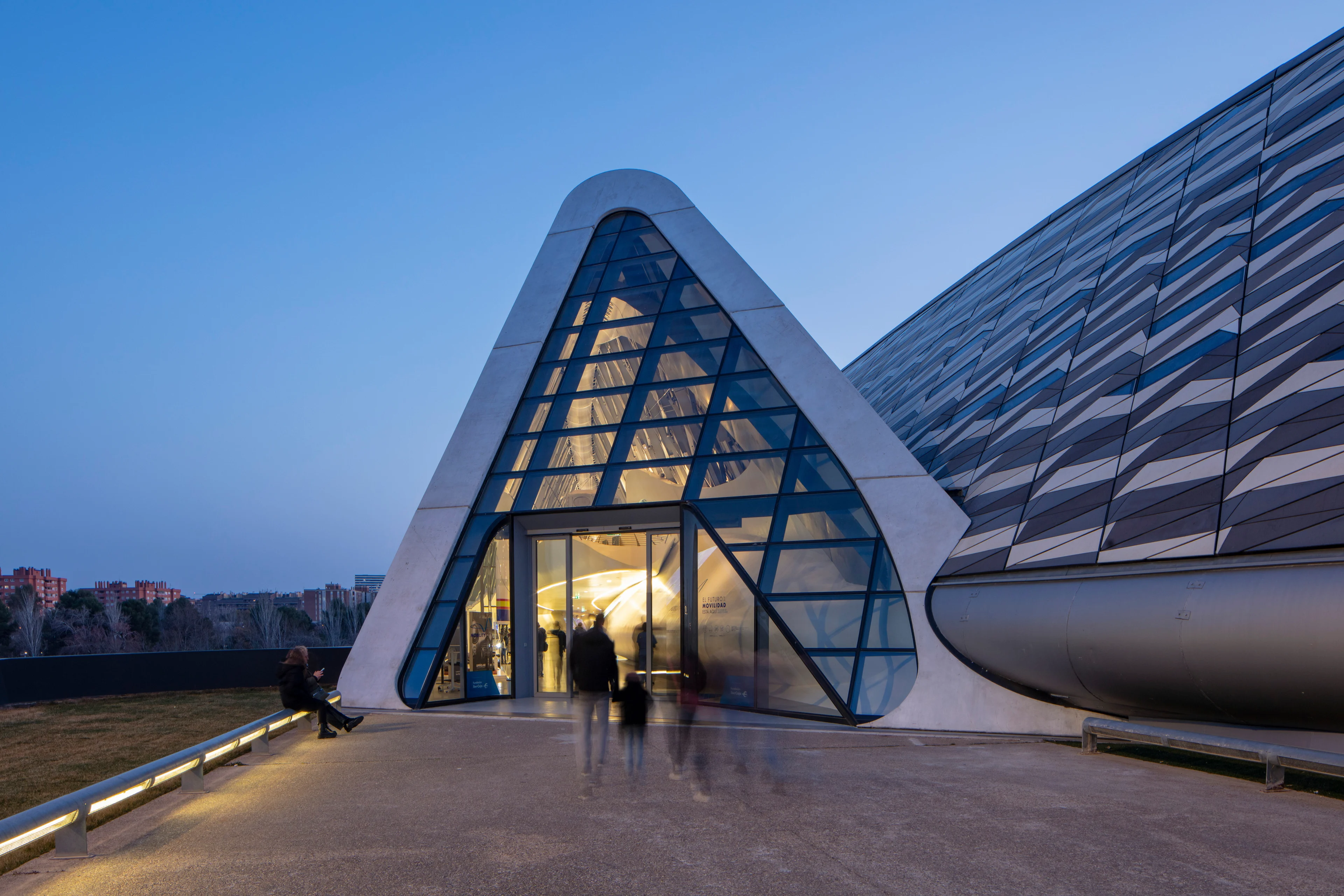
Two pods housing exhibitions are acclimatized with an entirely enclosed structure. The remaining two pods are clad by a single-layer skin which leaves the grid structure visible from the inside. These two pods include small triangular apertures, with larger openings located at lower levels, allowing for the greatest degree of visual contact with the river and the Expo.
Natural surfaces have been investigated when designing the Pavilion’s exterior skin. Shark scales are fascinating paradigms both for their visual appearance and for their performance. Their pattern can easily wrap around complex curvatures with a simple system of rectilinear ridges. For the Bridge Pavilion, this proves to be functional, visually appealing and economical.
Photograph by Luke Hayes
March 2023
Photograph by Luke Hayes
March 2023
Photograph by Fernando Guerra
Photograph by Luke Hayes
March 2023
01
02
03
04
A free-form geometry allowed for by the flexibility of its constituting material
The outer skin is split longitudinally into two elements: a lower deck made of structural metal plates, and on the higher level, a cladding system of glass-reinforced concrete (GRC) panels in various shades from white to black.
The lower deck follows a free-form geometry allowed for by the flexibility of its constituting material. The curvature of the upper level has been rationalized into sections of cylinders that have been subdivided into 26,500 rectangular panels of equal size. A pattern of triangles has been inscribed into these panels, limiting the variation to 10 inscriptions which, when combined with the chromatic variation to the GRC panels, creates the array of optical patterns visible on the Bridge Pavilion’s façade. The bridge’s internal skin constitutes of a smooth semigloss surface of plasterboard finished with several layers of polished polyurethane resin.
At 68.5m the Bridge Pavilion’s foundation piles are the deepest ever constructed in Spain. 62,500 steel structural elements have been prefabricated in nine metal-fabrication workshops and subsequently assembled on site.
The north portion of the Bridge Pavilion’s structure, comprising three pods, weighs 3,500 tons and was constructed in its final location on a temporary peninsula built in the river. The south part, weighing 2,200 tons, was assembled on the south bank of the river. It was pushed into position on the river bed, first on sleds, then by means of a 42 m high pulling tower – a complex manoeuvre due to the asymmetrical geometry of the bridge.
Transport + Infrastructure
Explore more transport and infrastructure
From an airport that sets new standards for service to a state of the art flood defense system that doubles as a public promenade, discover our latest transport and infrastructure projects.
Photograph by Hufton + Crow
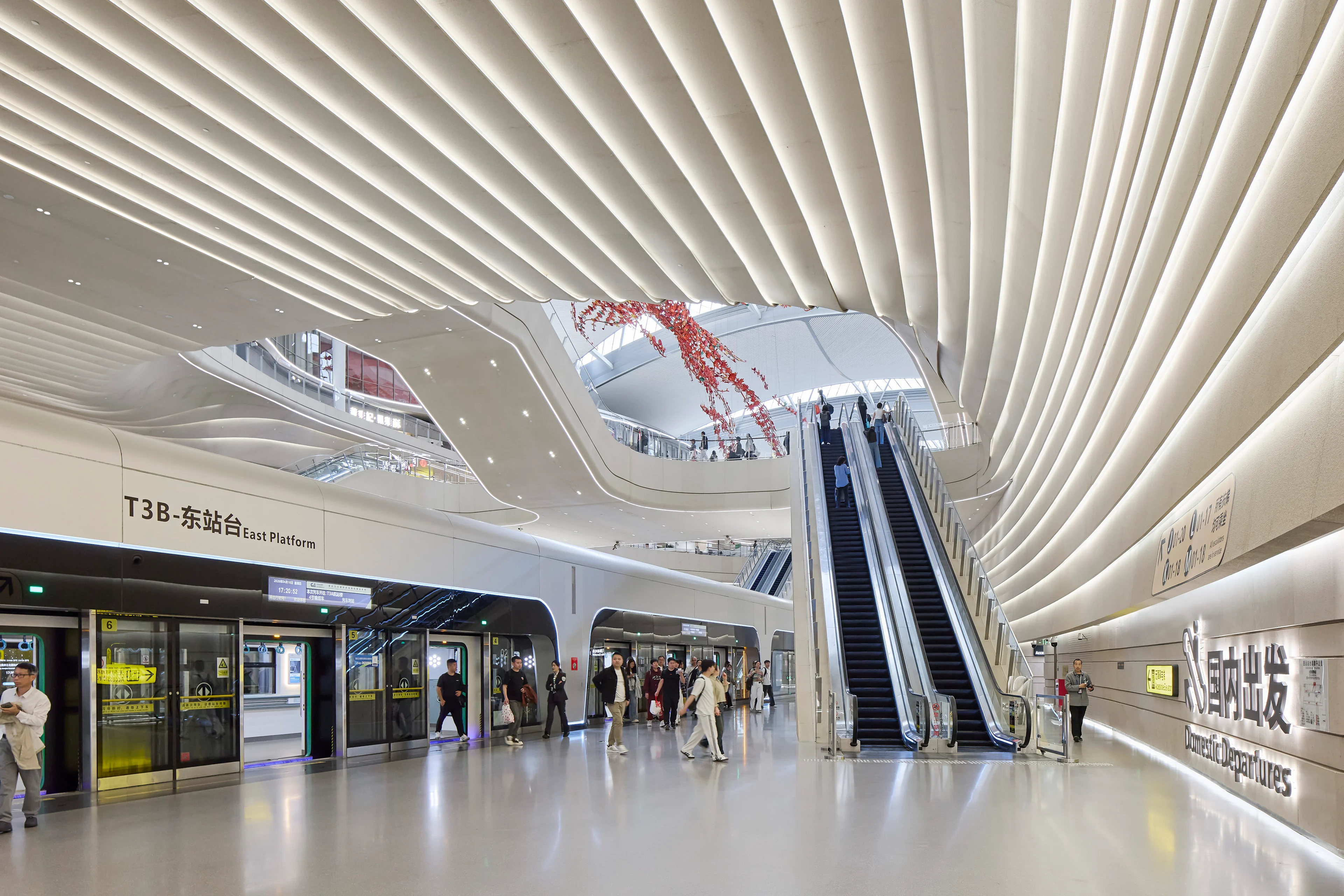
Terminal 3B at Chongqing Jiangbei International Airport
The new Terminal 3B (T3B) at Chongqing Jiangbei International Airport is a ZHA design collaboration with the terminal’s executive architects CSWADI (China Southwest Architectural Design & Research Institute). Constructed by CSCEC (China State Construction Engineering Corporation), T3B marks the final large-scale expansion of the airport’s transformation into one of the country’s leading aviation hubs.
Render by X-Universe
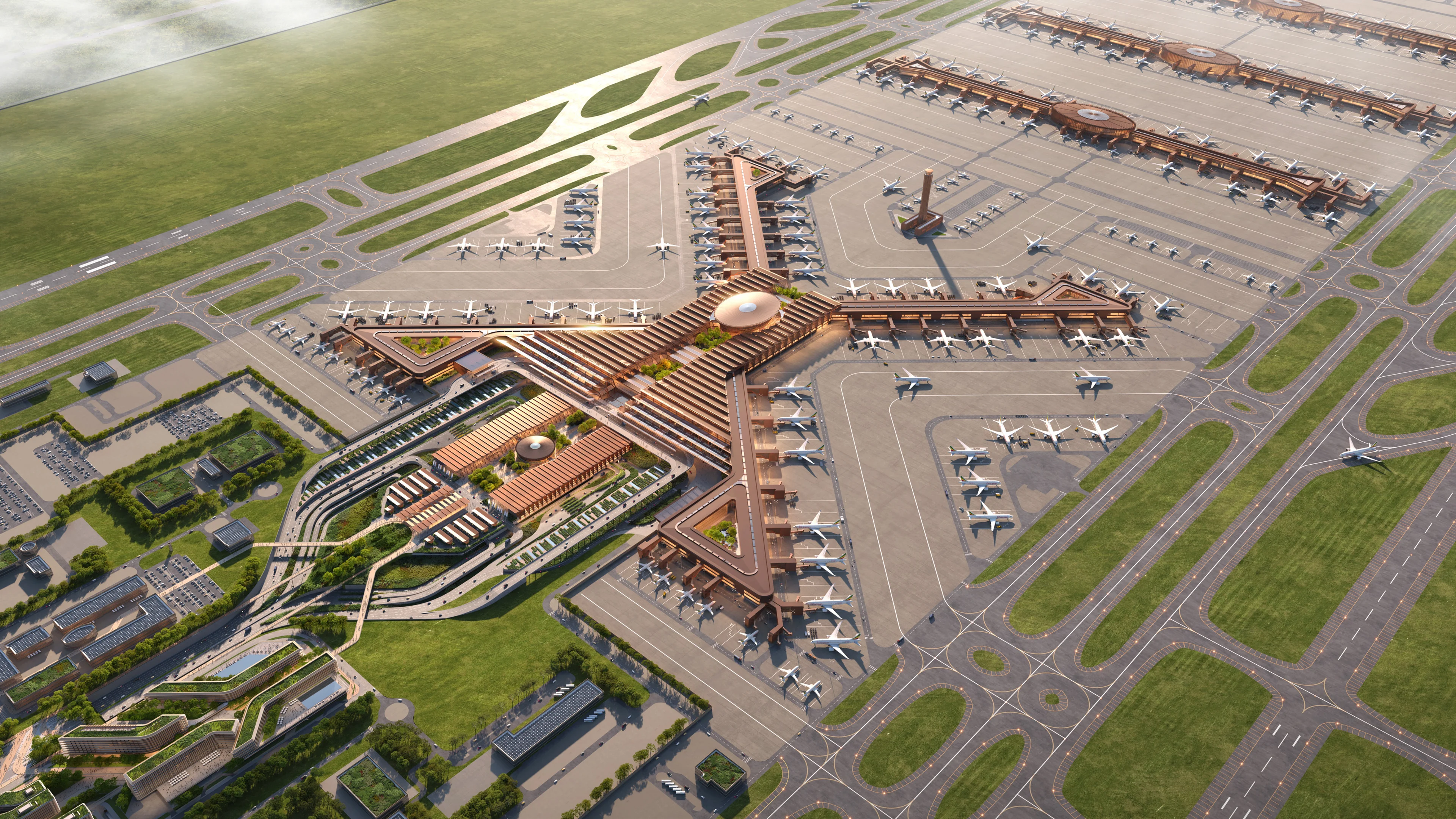
Bishoftu International Airport
Phase One of the new Bishoftu International Airport (BIA) will serve 60 million passengers a year. Further phases will serve up to 110 million passengers annually with four runways and parking for 270 aircraft.
Photograph by Xue Liang 薛亮
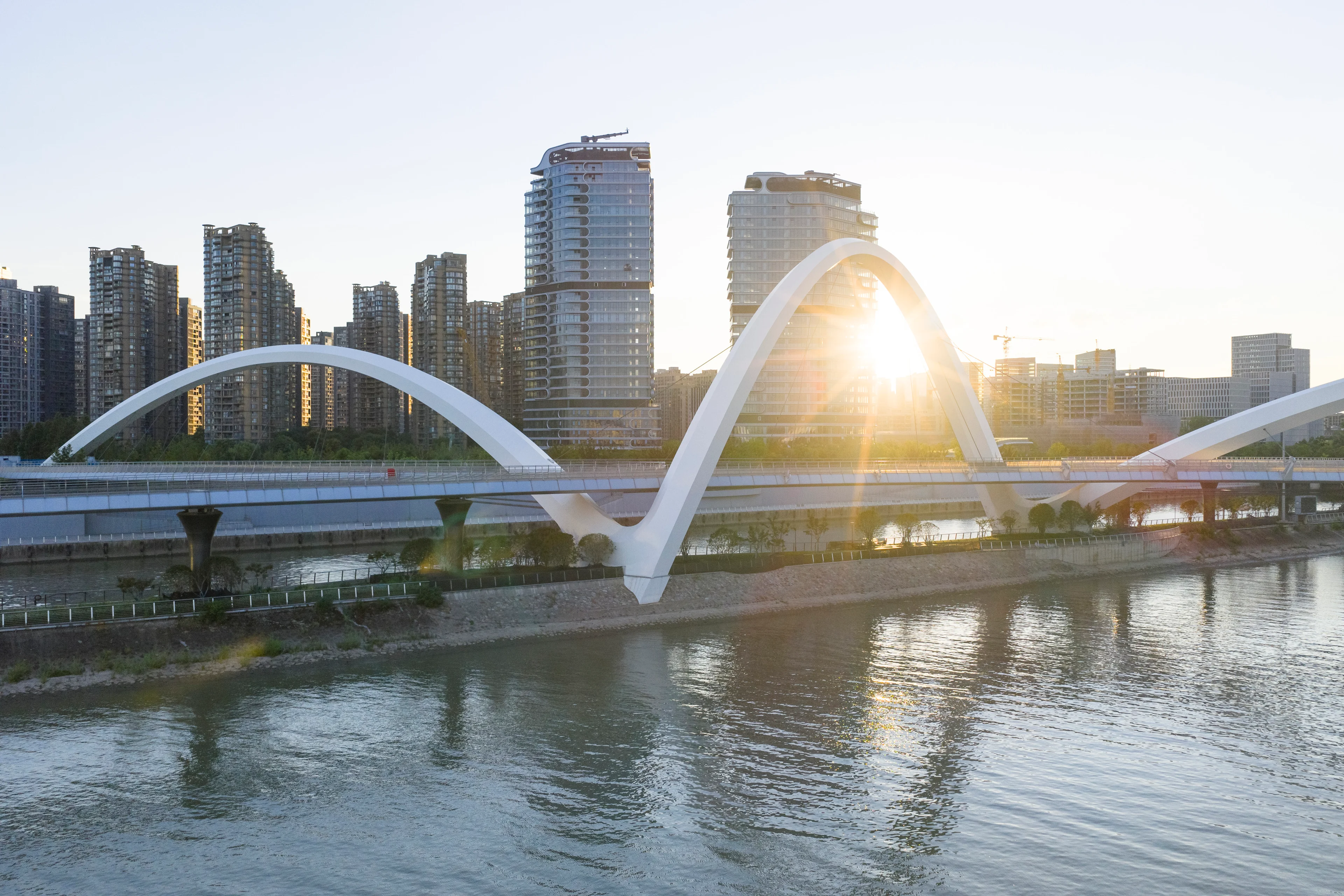
Grand Canal Gateway Bridge
Grand Canal Gateway Bridge
Uniting cultural heritage with 21st century engineering and recyclable materials, the Grand Canal Gateway Bridge is both sculptural and sustainable, designed for longevity with minimal environmental impact.
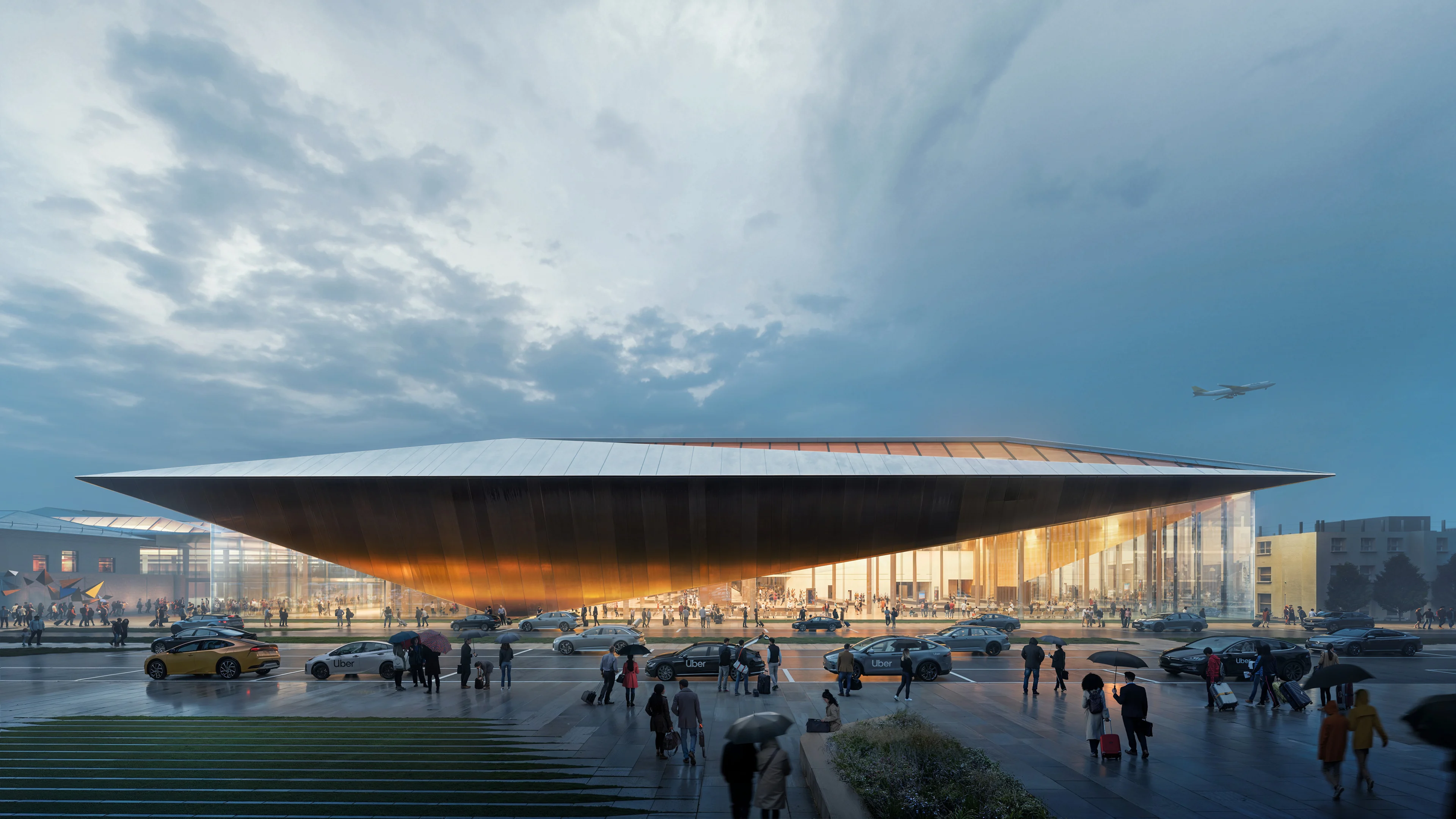
Vilnius Airport Terminal
ZHA's design draws from Lithuanian cultural heritage, incorporating traditional motifs and art forms within a contemporary architectural language. The terminal's modular geometry originates from the rhombus, a triangular shape that holds significant meaning in Baltic folklore.
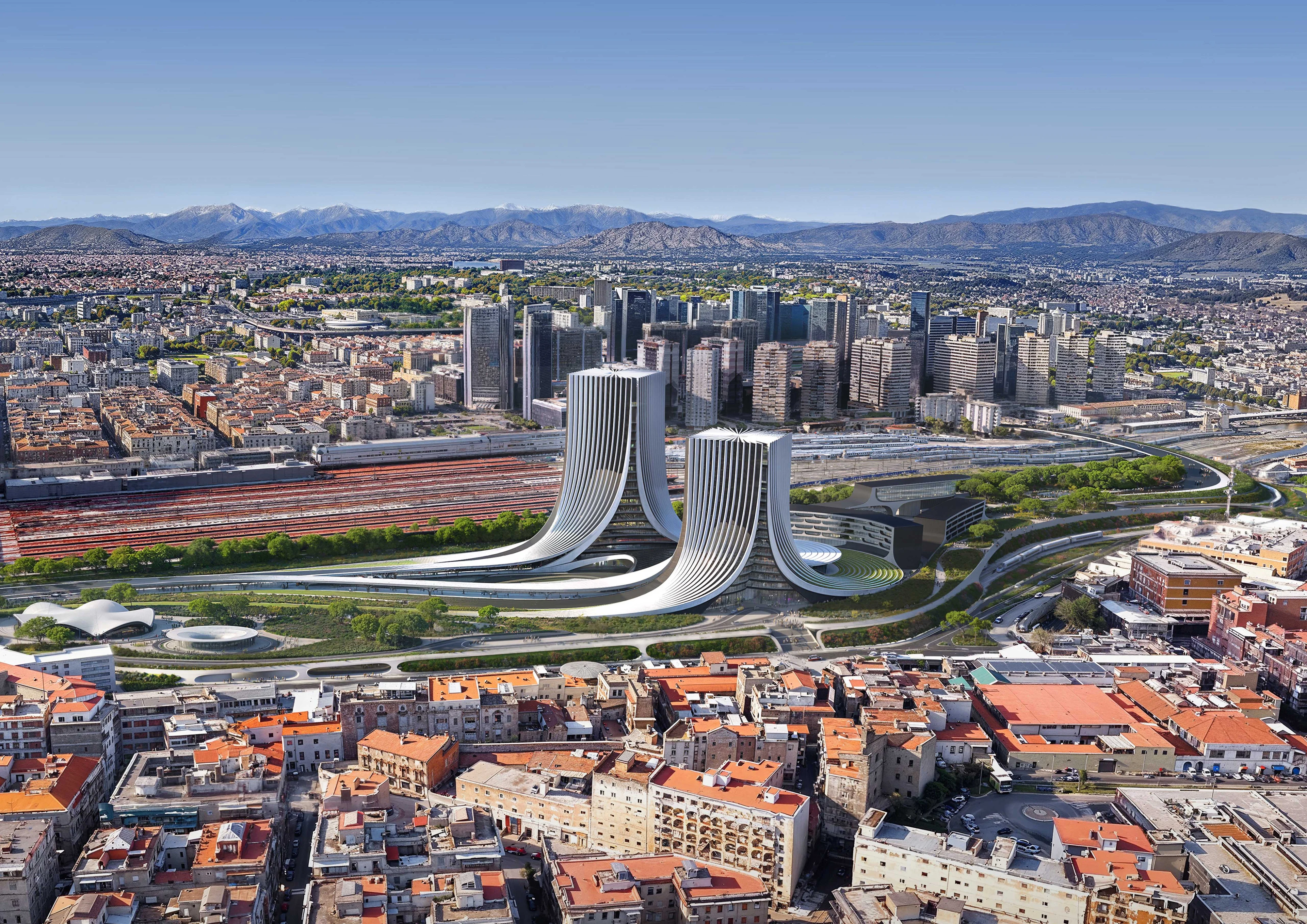
Napoli Porta Est
A large-scale urban regeneration project in Naples that reconnects the city’s fragmented urban fabric and incorporates the new Campania Region headquarters.
Render by Tecma Solutions
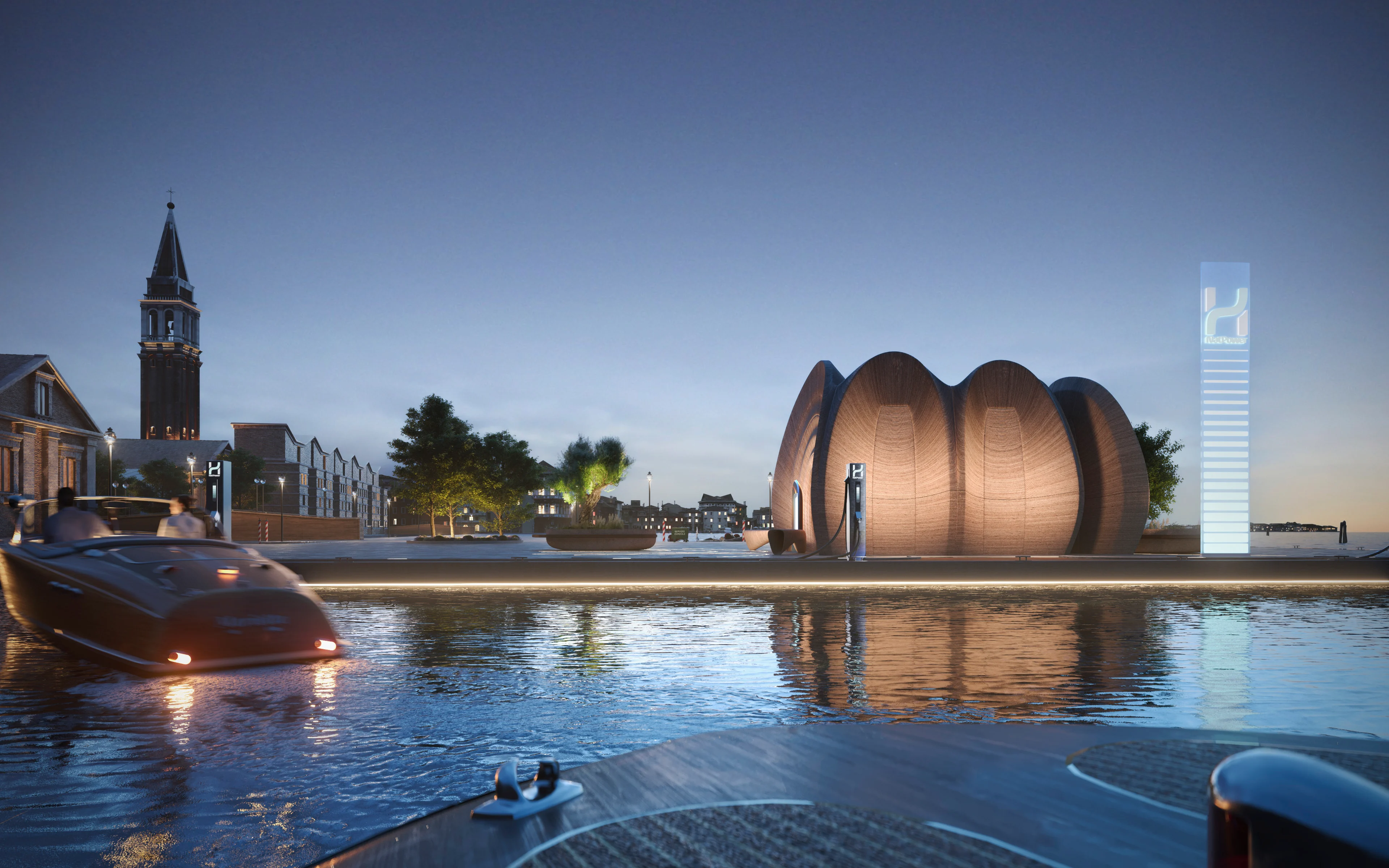
NatPowerH Hydrogen Refuelling Stations
The world’s first green hydrogen refuelling infrastructure for the recreational boating industry will be initiated in 25 Italian marinas and ports with stations designed by ZHA.
Render by Negativ
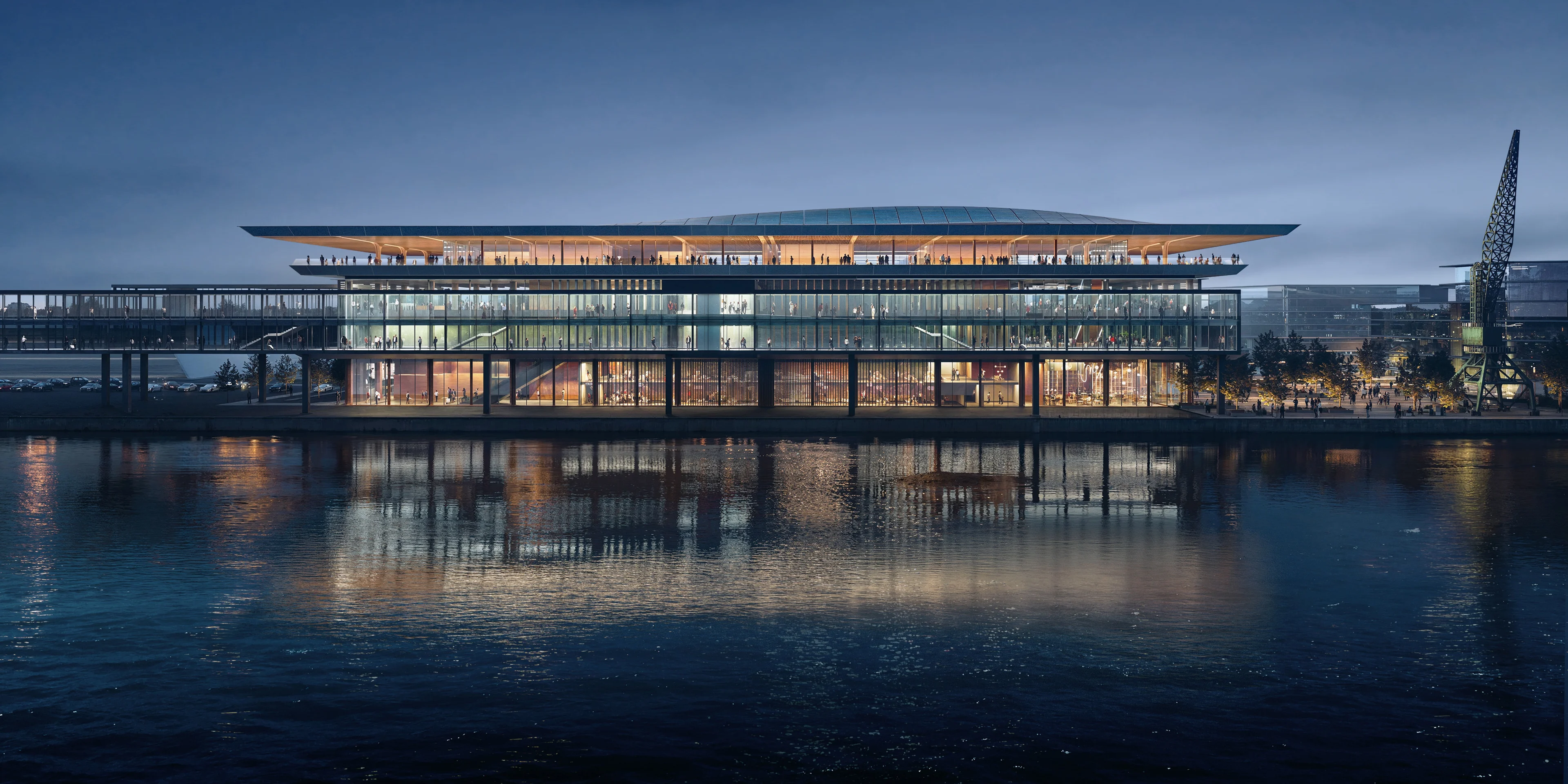
Ropax Ferry Terminal
Repurposing an existing shipping warehouse built in 1960 into a new 20,000 sq. m ferry and cruise ship terminal, ZHA’s design adds a fourth level to the structure to incorporate public terraces with panoramic views of the Daugava River and the skyline of Riga’s city centre, a designated UNESCO World Heritage Site.
Photograph by Xue Liang 薛亮
Jiangxi River Bridge
Jiangxi River Bridge
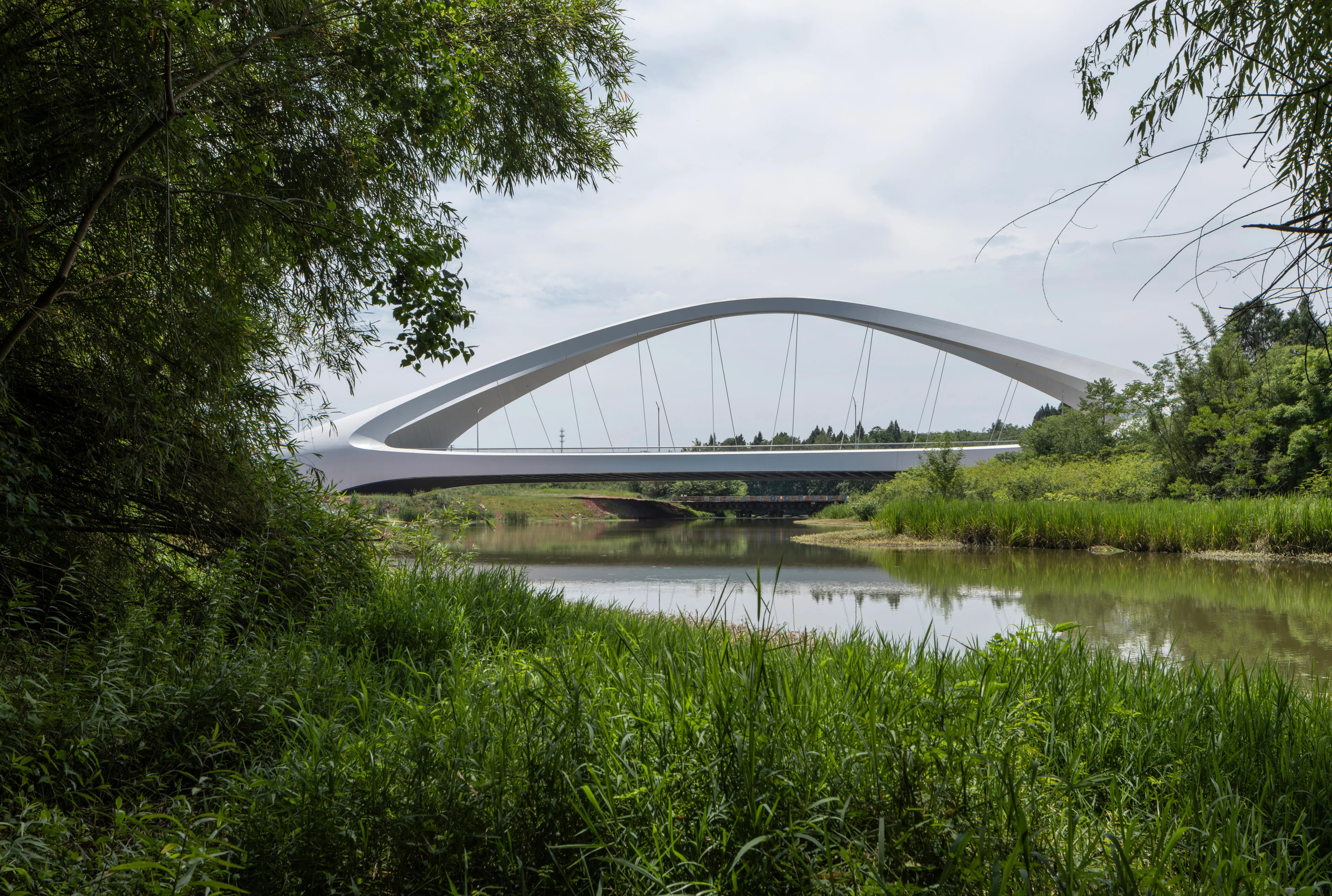
The first in a series of bridges on Chengdu’s West Line Road, the new 295-metre Chengdu West First Bridge crosses the Jiangxi River, a tributary of the Tuojiang River in China’s Sichuan province.
Render by Atchain, courtesy of ZHA
Dnipro Metro Stations
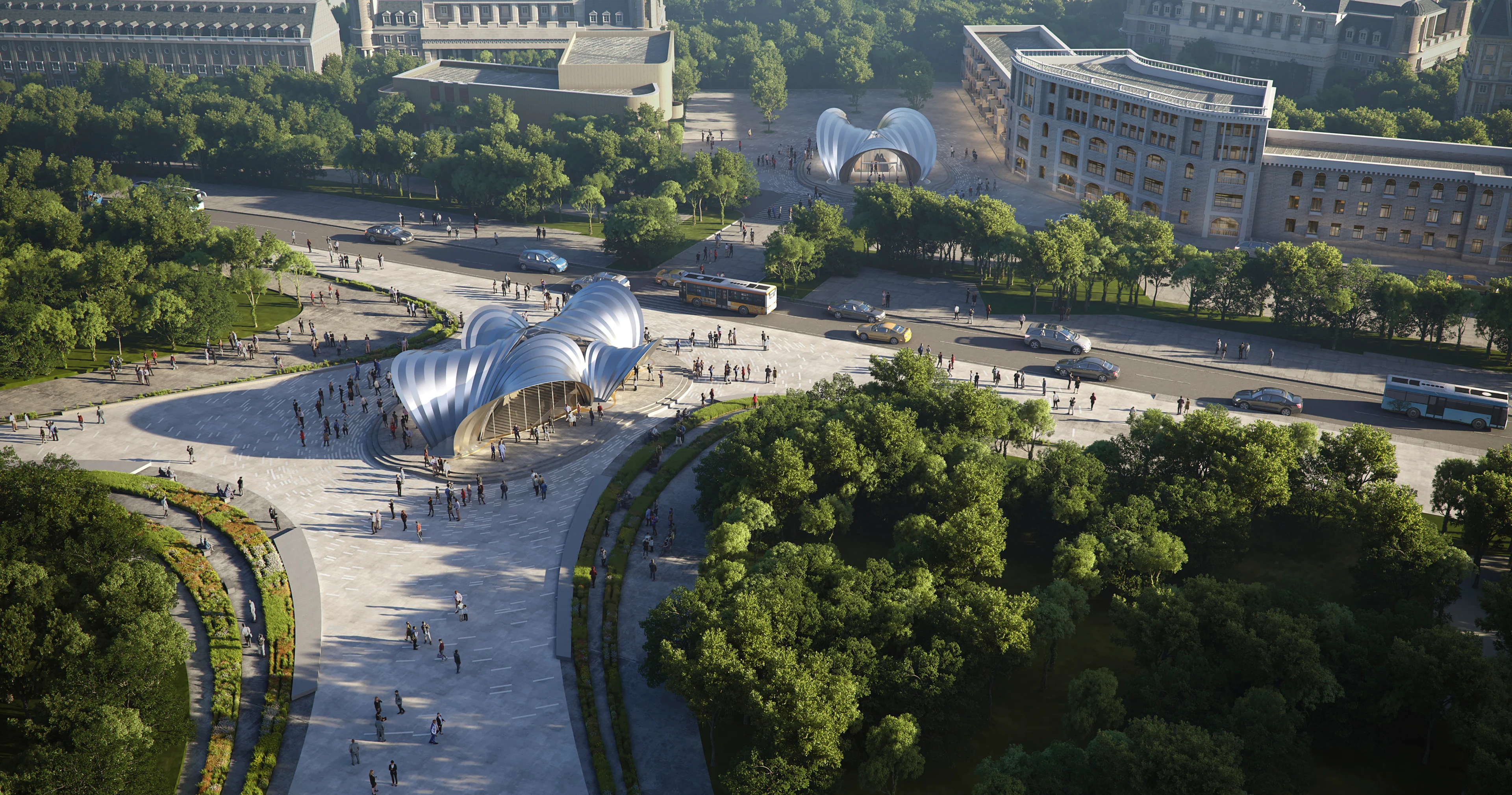
The three new stations (Teatralna, Tsentralna and Muzeina) designed by ZHA will connect the residents, businesses, cultural and academic institutions in Dnipro’s eastern districts with the city centre and the Dnipro-Holovnyi railway terminus.
Courtesy of ZHA, render by Negativ
Vilnius Railway Station
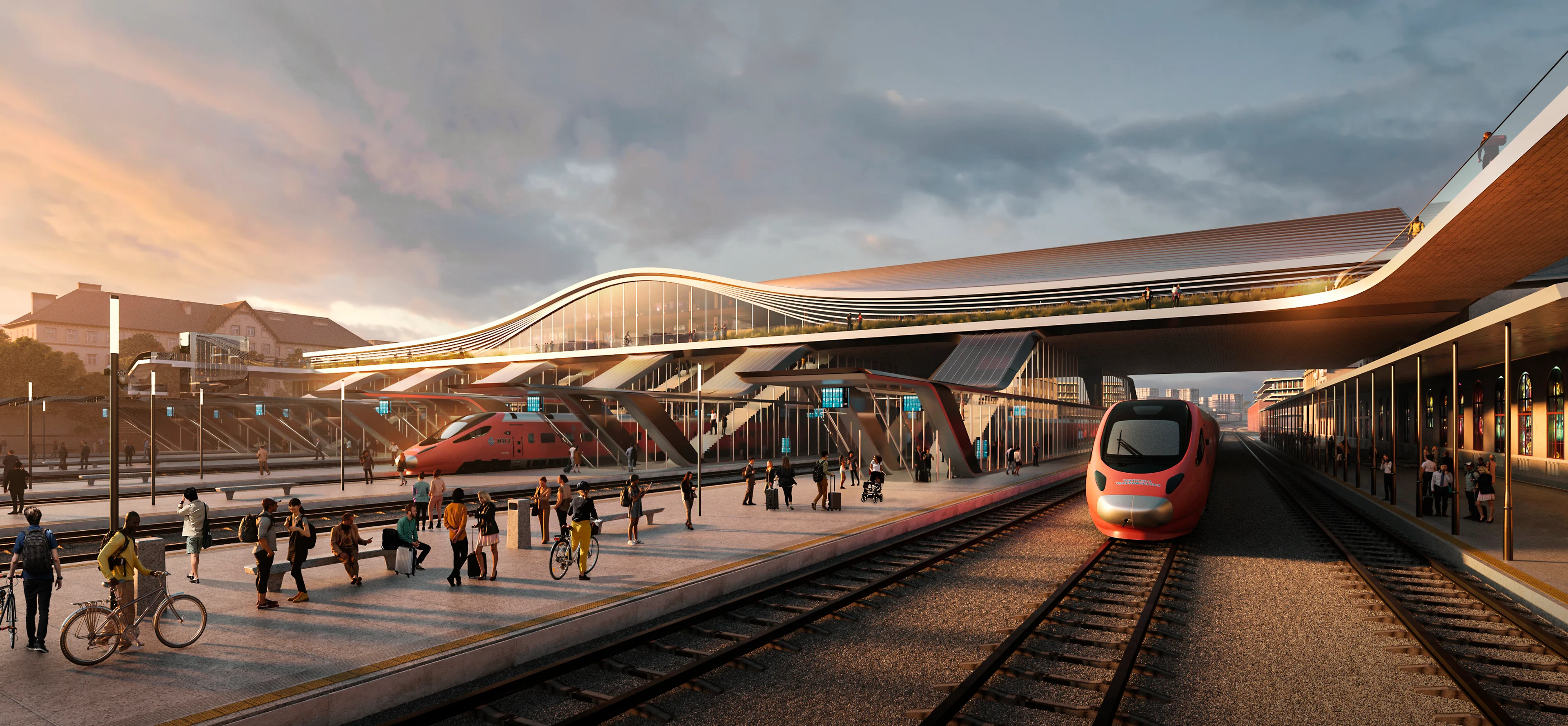
ZHA’s ‘Green Connect’ proposal for Vilnius Railway Station creates an integrated transportation hub for the 21st century with new civic spaces enveloped by nature
Photograph by Werner Huthmacher
Alpenzoo Station
Nordpark Cable Railway Stations
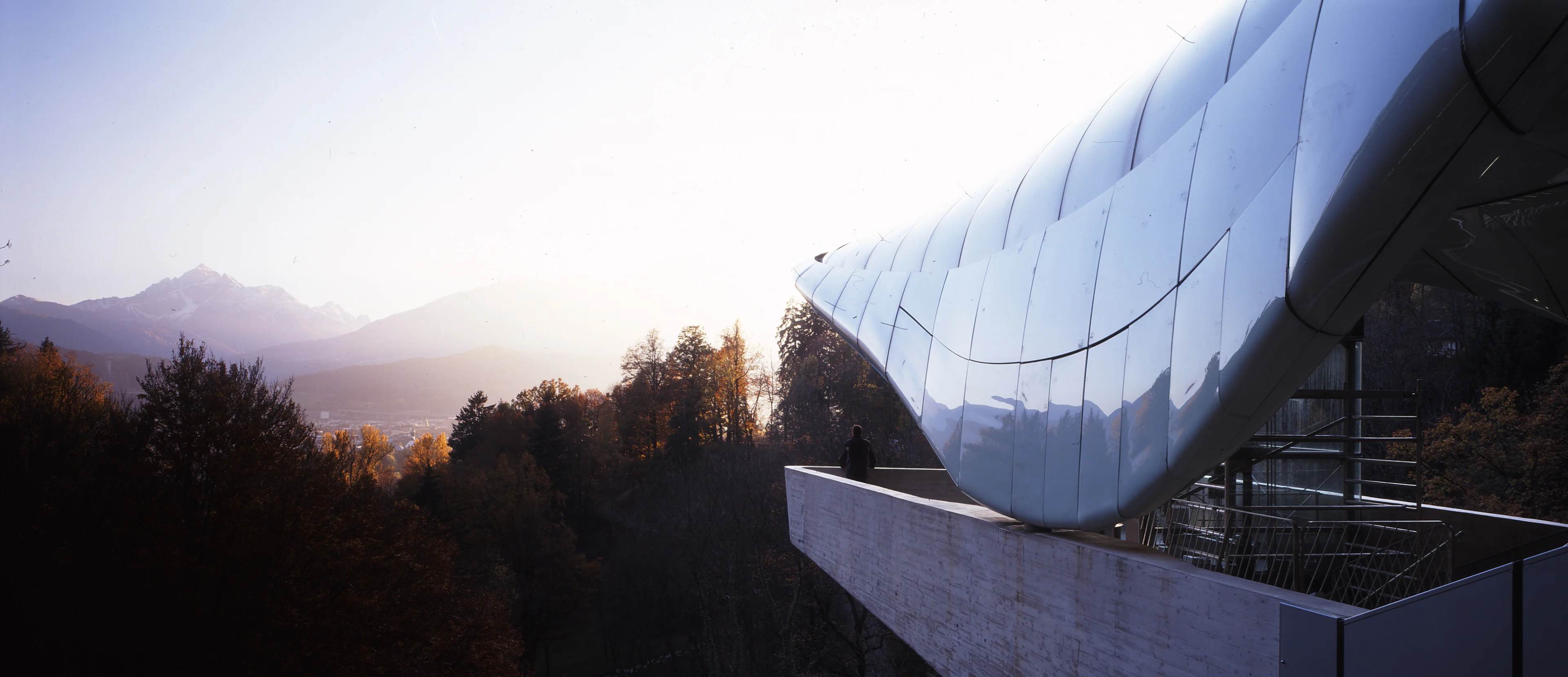
‘Shell & Shadow’: a unique architectural language of fluidity inspired by natural ice formations, for stations along Innsbruck’s northern chain of mountains. Lightweight organic roof structures float on concrete plinths, their soft shapes and contours creating an artificial landscape that describes the movement and circulation within.
Photograph by Hufton + Crow
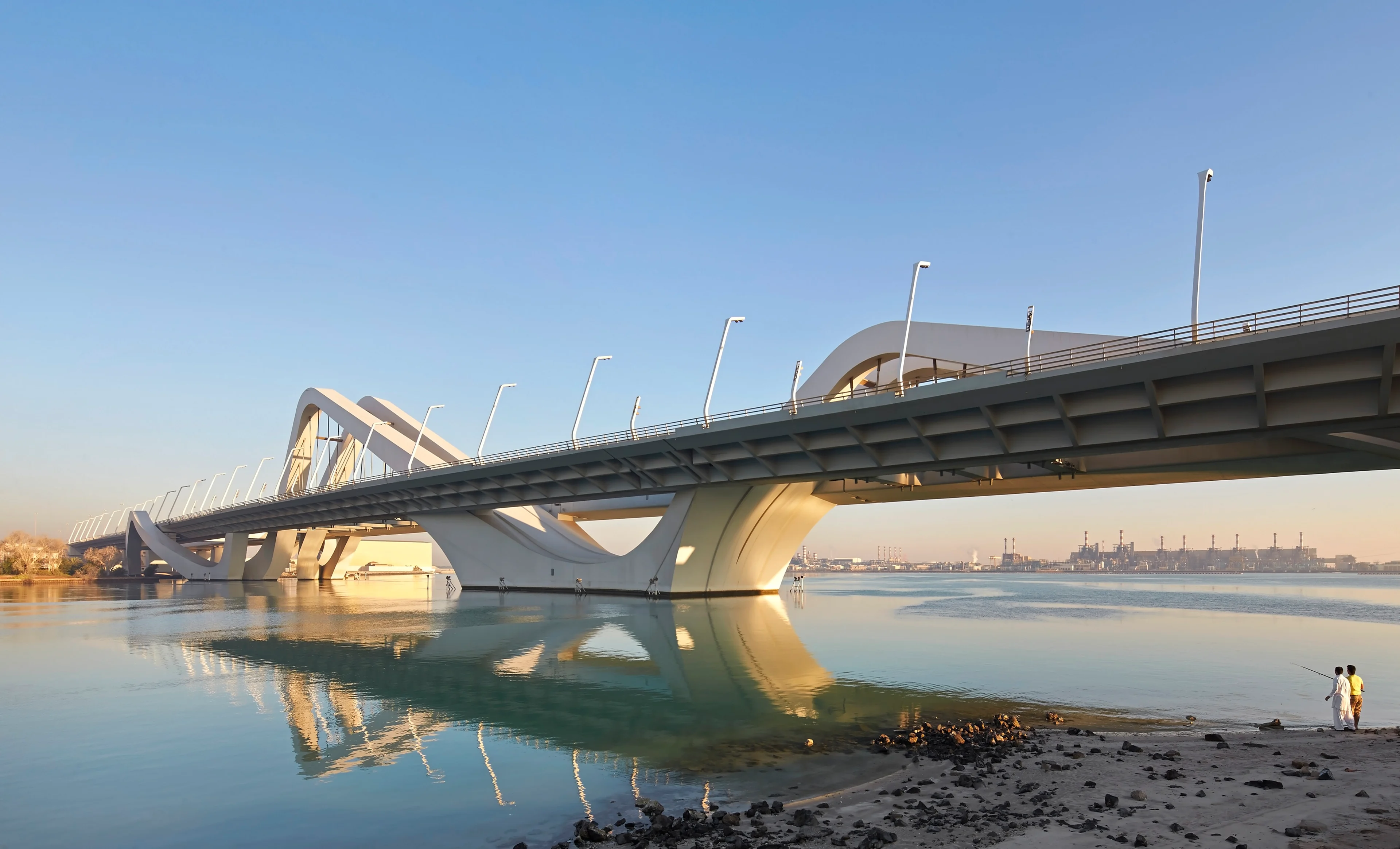
Sheikh Zayed Bridge
Design and construction of a third gateway crossing linking Abu Dhabi Island to the Gulf south shore. Our two-way four lane highway bridge features cantilevered road decks suspended from symmetrical steel arches, which form a sinusoidal waveform – giving this huge structure its fluid silhouette.
Photograph by Roland Halbe
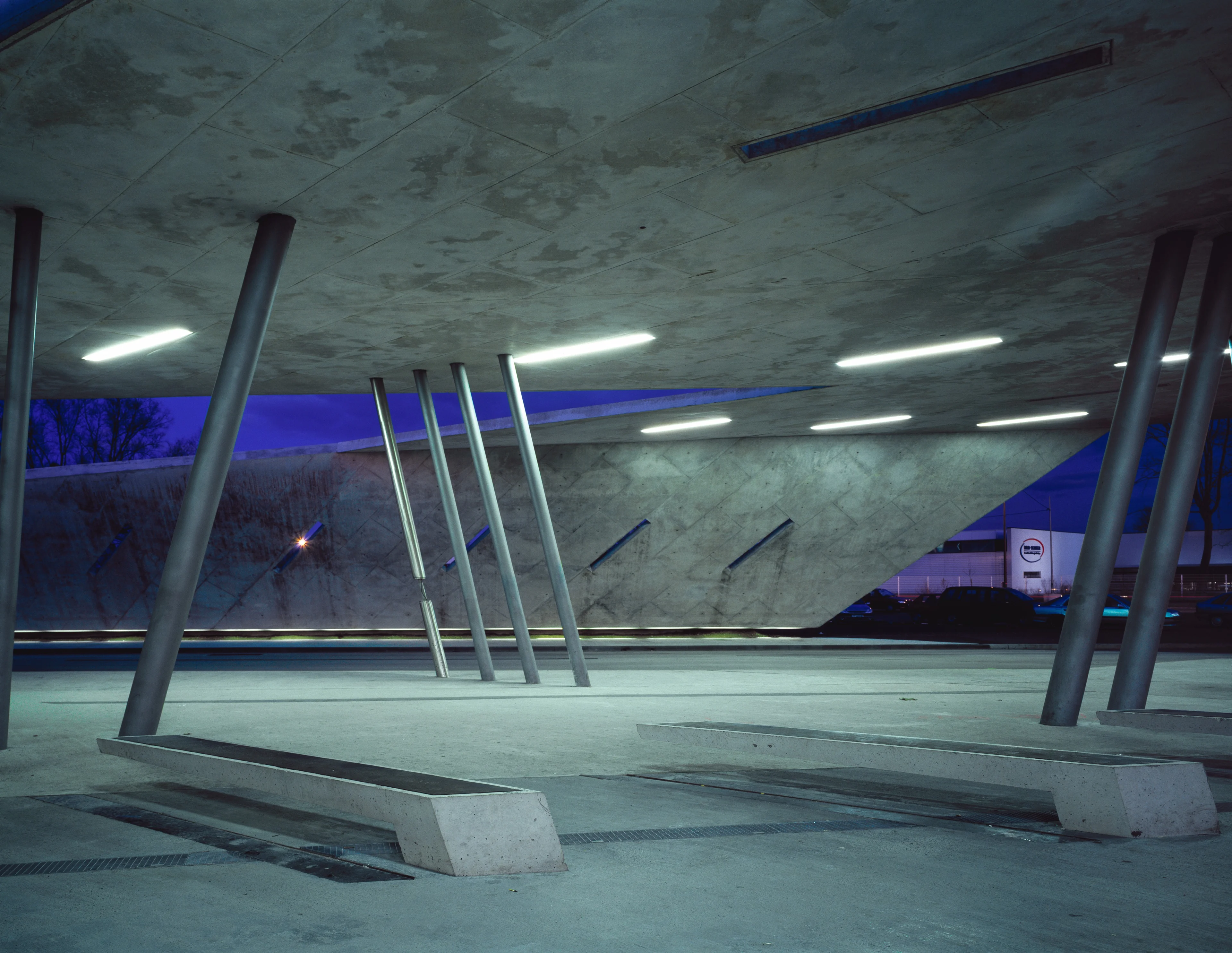
Terminus Multimodal Hoenheim Nord
Completed for the northern terminal of the city’s B tramline, our concept utilises overlapping fields: echoing the energetic movement of cars, trams, bicycles and pedestrians; fusing together to form a constantly shifting but clearly delineated whole. In the car park, floor marks and light posts delineate a ‘magnetic field’.
Photograph by Hufton + Crow
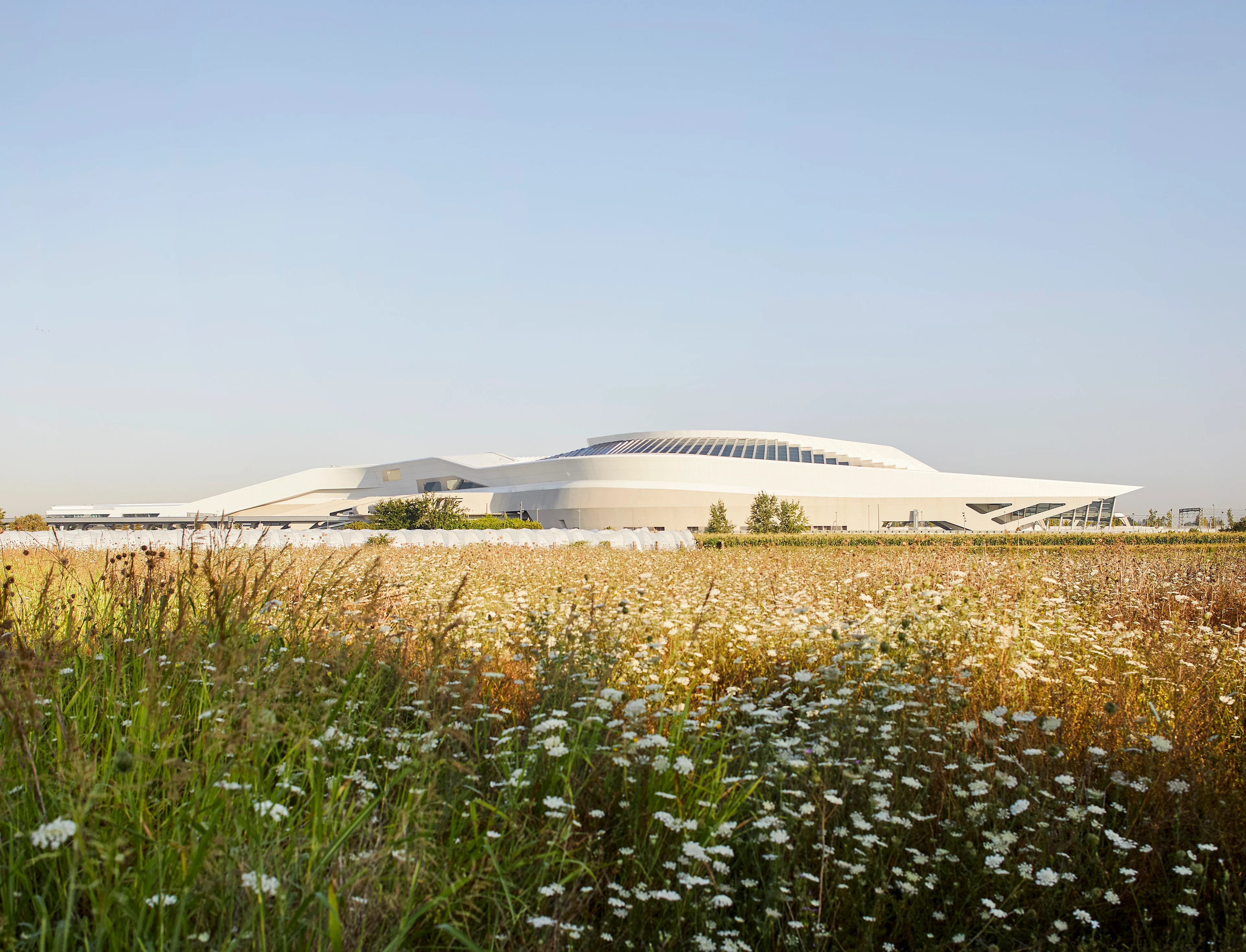
Napoli-Afragola High Speed Train Station
The new rail station at Napoli Afragola is designed as one of southern Italy’s key interchange stations serving four high speed inter-city lines, three inter-regional lines and a local commuter line.
Photograph by Piet Niemann
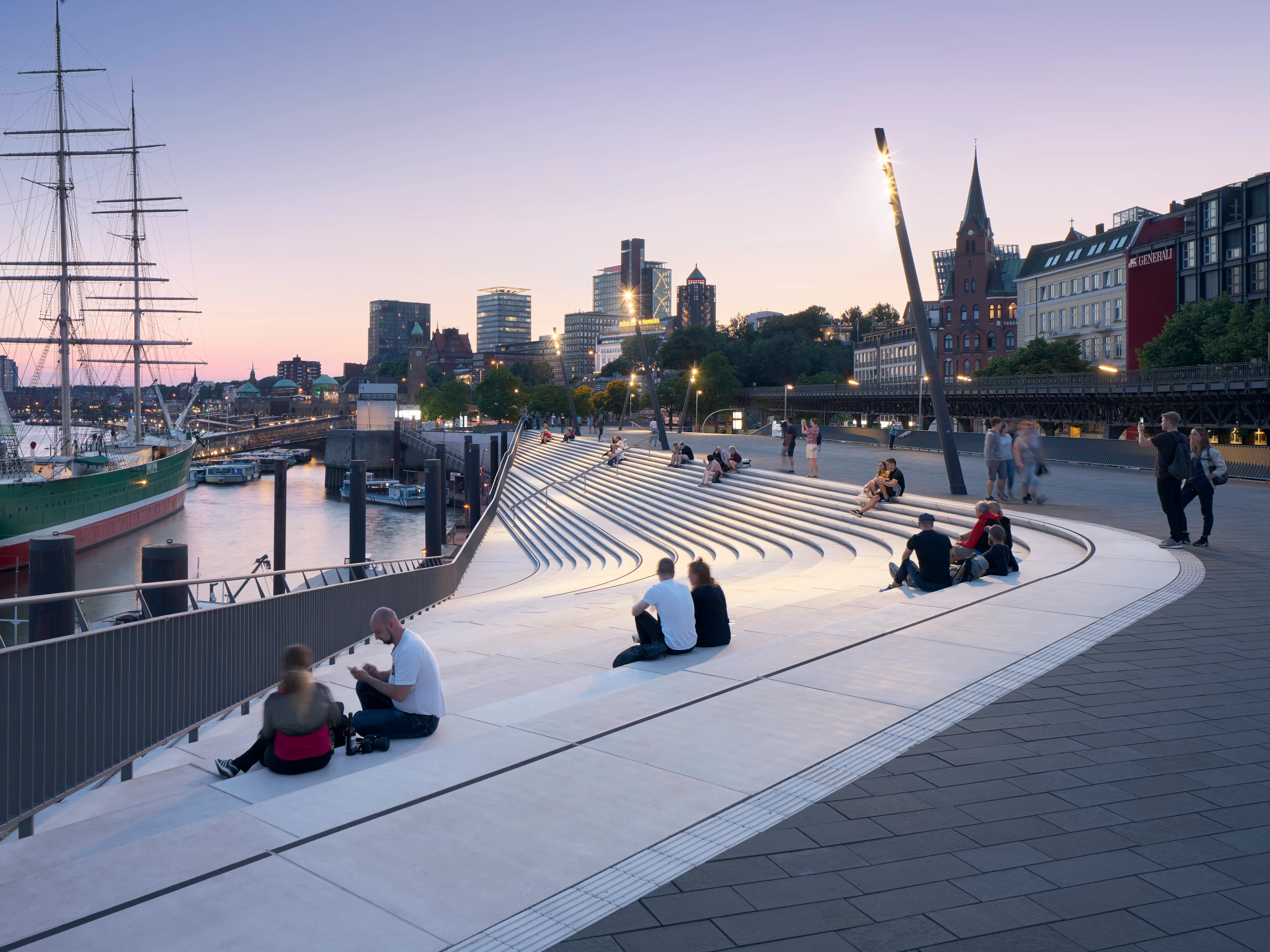
Niederhafen River Promenade
Located at Niederhafen on the Elbe River between St. Pauli Landungsbrücken and Baumwall in Hamburg, the upgraded 625m river promenade is integral to the modernisation and reinforcement of the city’s flood protection system.
01
02
03
04
05
06
07
08
09
10
11
12
13
14
15